Sider

fredag 8. juni 2018

Kurapaty standoff: Dashkevich says tents near restaurant not feasible | euroradio.fm


Activists
should not put up tents near the restaurant 'Poedem, Poedim' situated
on the Kurapaty memorial in Minsk's suburbs because it is not feasible, Zmicier Dashkevich said in a video stream on Facebook.


Tents near Kurapaty will not yield a good result because few people
will be able to participate in this struggle, Dashkevich reckons. “Maybe
a dozen people will stay there for a few weeks but the number will be
decreasing with time,” he said.


The activist suggested two other forms of protest. Firstly, an
economic boycott can be started. Journalists have found out who the
owner of the restaurant is and it would be worth boycotting their
businesses, Dashkevich said.


He also suggested exercising moral pressure on visitors and employees
of the restaurant: leaflets containing information about Kurapaty
should be given out.


“Kurapaty is a sacred place, you cannot do one thing today and
something else tomorrow," Dashkevich argues. He also suggests that
activists should take stock of their resources before organizing the
defense of Kurapaty.


Pavel Sevyarynts detained by the police yesterday evening has already been released, Dashkevich said.
https://euroradio.fm/en/dashkevich-installing-tents-near-restaurant-kurapaty-unreasonable

mandag 17. juli 2017

NATO sees no threat in West-2017 military exercise

NATO sees no threat in the military exercise West-2017, Secretary General of NATO Jens Stoltenberg told journalists after the exchange of information between Russia and NATO.

Any country has the right to conduct manoeuvres and there is no need to see a threat in it, Stoltenberg said.
Russia has informed the other states about the number of soldiers that will participate in the manoeuvres and about the number of air forces. This number does not exceed the limit indicated in the Vienna Document.
The number of soldiers participating in the manoeuvres may be bigger than declared, NATO thinks.  However, the alliance still sees no threat in it.
The military exercise West-2017 will be conducted on September 14-20. The North Atlantic Treaty Organization will watch them.

Kilde:  https://euroradio.fm/en/nato-sees-no-threat-west-2017-military-exercise

søndag 2. juli 2017

Belarus raised export duties on oil and oil products

On July 1, Belarus increased the export duties on oil and oil products exported outside the EurAsEC customs territory.
According to BelaPAN with reference to the press service of the Belarusian government, the decision is based on the Decree #484 of the Council of Ministers passed on 27 June 2017.
The crude oil export duty has risen from 80 to 80.9 dollars per ton, for gasoline — from 44 to 44.4, for the light and middle distillates — from 24 to 24.2. The same duty was set for diesel fuel, benzene, and other kinds of lubricating oils.
Previously, the rates were reduced on June 1, 2017, but before that they rose in March, February, and last fall.
belsat.eu

Why were patriots released?

On June 30, Miraslau Lazouski, the last suspect in the 'patriots' case', walked out free after having spent three months and ten days behind bars. However, the criminal case against the former leader of White Legion remains open. He and other fellow 'patriots' face charges of forming an illegal armed unit. At the same time, it is hardly a coincidence that 11 people connected to this criminal case were released in the course of three days.

Why did authorities open the 'patriots case'?

The 'White Legion' criminal case (also known as the 'riot case' or the 'patriots case') was opened after Aliaksandr Lukashenka's statement about "a bootcamp to train rebels in a forest near Asipovichy." Detentions took place in the evening of March 21. The first detainees were the former White Legion leader Miraslau Lazouski, book seller Ales Yaudakha, and a Ministry of Emergency officer Andrei Dundukou. A total of over 20 people ended up in jail.
"The tasks that the regime planned to achieve using the 'riot case' have been accomplished," reckons political commentator Yury Chavusau. "It was mainly about propagana aiming to adjust public opinion inside the country. The case was opened in March 2017, the time when a wave of social and politial protests swept across the country. The protests were significant, prompting the authorities to return to the old repressive tactics: hundreds of detainees, dispursed demonstrations and the climax - Freedom Day on March 25 when an opposition action did not actuallytake place after security forces had blocked the city center in Minsk.
The authorites initiated this politically motivated case in order to adjust the image of law-enforcement agencies. State-run newspaper headlines lamented about a thwarted coup d'etat, while TV propaganda and fabricated videos showed 'horror stories' about "Belarusian radicals." The state simply invented this case in order to divert public discontent away from the law-enforcement agencies busy with suppressing social protests."
"I would like to remind you that detentions of [patriots] took place when Belarus de facto was in a grave economic situation. The oil and gas dispute with Russia had not been resolved yet," says political analyst Аles Lahviniec. The 'patriots case' was a clear signal to Moscow."

Patriots released before the Independence Day parade?

Why were the patriots released this week? Jokers on social media suggested that Lazouski &Co would take part in the Independence Day parade instead of Russian paratroopers who are not participating this year. However, on a more serious note political commentators link their release with the OSCE Parliamentary Assembly session that Minsk will host next week.
"There is a direct connection," believes Ales Lahviniec. "Obviously, the White Legion case was far-fetched. Now it is simply falling apart. In order to avoid protests during the OSCE Parliamentary Assembly session, the authorities have moved to release the prisoners. Based on the previous experience, authorities in Belarus release prisoners "in bulk" when they wish to please the West. The people who stayed for over three months behind bars were simply hostages. Now that they are released, the authoirites like as if they have made some progress."

"The protests have died out. In this situation, the 'patriots case' has turned into an obstruction at the foreign political scene. It is a fact that the European Union did not stop cooperation with Belarus but nevertheless European leaders expressed concern over the situation," Yury Chavusau continues. As a result, all of the suspects were cleared of the preparation for a riot charges. Does it mean that all the charges published on the front pages by state-run newspapers were lies?"

What do Belarus authorities want from Europe?

Minsk will bring its game it started three months ago to the end. However, it is too early to say that by releasing all the patriots the government will manage to mitigate all possible foreign policy consequences. Political analyst Andrei Kazakevich reckons the EU will obviously welcome the release of political prisoners and adds that the release of Lazouski has no specific purpose:
"This step is not about gaining something new. Rather, it is about not creating new obstacles for good dynamics that can be currently observed in the Belarus-EU relations."
Andrei Kazakevich. Photo: Euroradio
"The patriots' case was a preventive psychological action against radicalization," Kazakevich continues. "[It was done] in order to demonstrate those who felt they had an opportunity to mobilize the population for more protests that there was no space for liberalization and that the authorities were prepared to respond. The case turned out to be psychologically effective. Foreign policy losses were minimal. The Belarus authorities have managed to preserve their face in relations with Europe."
Kazakevich reckons the patriots' case will not be closed and end up in court. But he expects no harsh sentences.

tirsdag 27. juni 2017

Oswald. The Minsk Mystery


The reputed Belarusian filmmaker Viktar Aslyuk has filmed the documentary ‘Oswald. The Minsk Mystery’.


In the film, Ernst Tsitavets, a resident of Minsk, relives certain experiences and tells about his friend Lee Harvey Oswald, the person who is allegedly responsible for assassinating U.S. President John F. Kennedy in
1963. The documentary is set in the block of flats Nr 4 in
Kamunistychnaya street, in the very apartment where the American
‘tourist’ lived after his arrival in Minsk. Ernst Tsitavets was then a
medical student and loyal Komsomol member, who, however, secretly
listened to the BBC. There they disputed on the standards of life is
better in the West and in the USSR.


“I did not keep my promises to make a great film, an extensive
investigation for, perhaps, only one reason – there are very few
witnesses left. Time was lost, I had to narrow it down, and finally, I
focused on the apartment.


The apartment has hardly changed. Its parket flooring, bathtub,
toilet, ceiling remain authentic. As a film director, I realized that
hundreds of movies telling the story of Oswald were made. And I did not
set the task to give a final answer to the question whether Oswald
killed or he did not. But I knew that there was one man in the city who
rarely appeared in films. He was one of the people who were close to
Oswald in his Minsk period – or even in his whole life, because Oswald’s
life was very short. […] Of course, in this case, I decided to follow
my character. I do not judge and do not intend to judge Oswald – it is
not my aim. But my character – Ernst Tsitavets – believes that Oswald
did not kill. And it is his emotional right, human right to think so.


When I started, I saw that anyone who would ever dig at this issue –
Oswald in Minsk – would touch the issue of Minsk itself without doubt.
The issue of the 1960s, when this man came and lived here. I admit
having a soft spot on the 1960s – maybe, due to old Soviet films. My
documentary features the best footage of the then cameramen,” the famous
film director told Belsat TV.


Belsat.eu


Canada lifts Belarus sanctions after 11 years

Canada is proceeding with a plan to ease trade restrictions imposed on Belarus 11 years ago, reports CBC News.
Canada's Foreign Ministry aka Global Affairs Canada said in a statement on Monday:
"This revised approach reflects Canada's acknowledgment that the government of Belarus has made progress in key areas, including the release of political prisoners and conducting a peaceful presidential election in October 2015. Canada also recognizes the constructive role played by Belarus in facilitating negotiations toward a ceasefire and peace agreement in Ukraine under the Minsk agreement."
After the new measure takes effect on July 12, 2017, only North Korea will remain on the restrictions list.
Ottawa imposed economic sanctions on Belarus over human rights violations during the presiential elections and a crackdown on the opposition.

Regnum publishes interview with Alexievich without permission

The Russian information agency Regnum has published an interview with Svetlana Alexievich without her consent.  The Nobel Prize laureate did not expect to be asked provocative questions.  Alexievich called the journalist’s statement about a coup d’état in Ukraine in 2014 absurd. “It was people’s desire to change the government,” she noted. However, the Regnum journalist would not calm down and kept insisting on ‘a coup d’état’. “When Ukrainians started protecting their country, you mentioned human rights that were not observed at war. You, Russians, behaved even worse in Chechnya,” the writer said.

Then they discussed the Ukrainian and Belarusian languages. Alexievich recalled the Russification and elimination of the Belarusian intellectual elite in the Soviet time and the 3 million Russians that came to Belarus after the WWII. Russia wants to absorb Ukraine and our country by means of Russification, she believes. Svetlana Alexievich touched upon the problems of freedom in modern Russia and the journalists did not like it. He asked her why she would not go to Donets Basin since she was writing about war. Russia was directly involved in the conflict in East Ukraine and “it is on Putin’s conscience”, Alexievich stressed.
“You invaded another country, why?” the writer asked. “There are millions of photos of Russian military machines there. Everyone knows who took down [that plane] and all this. Let us stop this stupid interview. I haven’t the energy for it. You are just a collection of propaganda, not a reasonable person.”

Kilde: https://euroradio.fm/en/regnum-publishes-interview-alexievich-without-permission

fredag 9. juni 2017

Belsat Music Live: «Stary Olsa» - Belarusian music.


Guests of the fifth edition of Syarhey Budkin program are the the honor and dignity of Belarusian music.


Mira Schultz is talking with the guests in the studio about their
inspiration in the past and present. The band members will tell her, why
they are not going  to play cover versions of rock classics in the
future and why they applied for popular funding. Of course, they will
talk about the success of the band in America — they will soon leave
again to perform overseas.


In a special story Khrystsina Darapey will tell the viewers how to launch a successful crowfunding project in Belarus.


Songs that will be performed in the program:


“Litvin” (folk music, the words of Zmitser Sasnouski), 3:33

‘Highway to Hell’ (music and lyrics by AC/DC), 3:28

“Knight Wheel” (folk music and lyrics, translated by Zmitser Sasnouski), 4:35

Reports: Belarus extradites Murad Amriyev

Belarus has extradited Murad Amriyev to Russia, Novaya Gazeta reports. The Chechen has not been allowed to ask for political asylum in our country (see video). Two columns consisting of three cars departed from Dobrush District Department of the Interior on the afternoon of June 8.  Amriyev was in one of them. He was handed over to the Russian police at Bryansk Oblast border.

World champion Murad Amriyev left Russia. The police had been torturing him and wanted his elder brother to return from Germany , he said. Amriyev was heading for Moscow from Ukraine to make a visa when he was detained. He was suspected of using fake documents but there was only a misprint in his passport. He became wanted by the federal police. The Chechen was released on June 6 and taken to the Transport Office of the Public Prosecutor for an interrogation. He saw Chechen policemen near the building and recognized one of them – the person who had tortured him 4 years before. Amriyev managed to leave the building and headed for Belarus together with friends. He was detained and jailed in Dobrush. Belarus was going to extardite him. It has happened despite numerous protests of rights defenders and Murad’s family who said that his life would be in danger in Groznyi.

Kilde:  https://euroradio.fm/en/reports-belarus-extradites-murad-amriyev

Murad Amrijev rømte til Hviterussland. Nå er han utlevert til Tsjetsjenia.

MMA-utøver på flukt fra tsjetsjenske styrker: – Han har blitt bortført og torturert der

Murad Amrijev (32) har vært på flukt fra tsjetsjensk politi i fire år. Nå frykter foreldrene for livet hans, om han blir utlevert fra Hviterussland.
 
Tirsdag ble den tsjetsjenske MMA-utøveren Murad Amrijev, tidligere amatørverdensmester, arrestert av hviterussiske grensevakter da han forsøkte å ta seg over grensen fra Russland.
Nå sitter han i hviterussisk arrest, med en utleveringsordre hengende over seg, ifølge den sterkt regimekritiske avisen Novaja Gazeta.
Om Amrijev blir deportert til den russiske republikken Tsjetsjenia, frykter både foreldrene og menneskerettighetsorganisasjoner at han risikerer å bli drept.
– Vi ber om hjelp til å forhindre at sønnen vår blir sendt til Tsjetsjenia, der han vil være i livsfare, sier de til den russiske avisen.
Menneskerettighetsorganisasjoner har kontaktet den europeiske menneskerettighetsdomstolen, fordi de mener at hans helse og liv er i fare, melder den russiske avisen.
Amrijev selv håper i det lengste at han kan bli værende i Hviterussland.
 – De gir meg ikke advokater, jeg får ikke lov å ringe, jeg har ingen rettigheter. Jeg vil ha politisk asyl her, sier han til den russiske TV-kanalen Dozjd, gjennom vinduet fra cellen sin.
Ifølge OC Media, skal en lokal byråkrat ha fortalt at utleveringen vil skje torsdag kveld eller fredag.

– Han har tidligere blitt bortført og mishandlet

Frykten for hva som kan skje med ham om han ender opp i Tsjetsjenia, stammer fra fire år tilbake.
Da skal 32-åringen han blitt bortført og torturert av lokale sikkerhetsstyrker. Ifølge menneskerettighetsorganisasjonen Memorial for å tvinge hans eldre bror hjem fra Tyskland.
– Han har tidligere blitt bortført og mishandlet der, og vi kunne ikke hjelpe ham, sier hans fortvilte foreldre, som fremdeles bor i Tsjetsjenia, til Novaja Gazeta.
Amrijev har fortalt at han ble mishandlet fordi en tsjetsjensk politisjef anklaget hans storebror for å forsøke å drepe ham. Siden politisjefen ikke kunne få tak i storebroren, som bor i Tyskland, pekte han seg ut Amrijev, skriver Radio Free Europe.
Ifølge flere medier skal politisjefen ha begynt en regelrett blodfeide mot Amrijev og broren.
Tsjetsjenia styres med jernhånd av president Ramzan Kadyrov, som en rekke menneskerettighetsorganisasjoner beskylder for å stå bak omfattende brutalitet mot befolkningen i republikken.

Arrestert i Russland – rømte til Hviterussland

Etter hendelsene i 2013 flyktet MMA-utøvere til Ukraina, og begynte å gå stevner der. Søndag reiste han tilbake til Russland, til byen Brjansk, ikke så langt fra den ukrainske grensen.
Amrijev skulle fornye visumet sitt, men endte opp med å bli anholdt av russisk politi på grunn av en trykkfeil i passet.
Han ble sittende i 48 timer i en provisorisk arrest, mens tsjetsjenske spesialstyrker ventet på utsiden, ifølge OC Media.
Tirsdag slapp det lokale politiet ham fri, og han greide å snike seg forbi vaktene utenfor. 24 timer senere ble han arrestert på den hviterussiske grensen.
– Vi ber om hjelp til å forhindre at sønnen vår til sendt til Tsjetsjenia, der han vil være i livsfare, sier Amrijevs foreldre i en video.

mandag 27. mars 2017

Norske Terje: Pågrepet under demonstrasjon i Hviterussland (Belarus)

Terje Hanssen forteller at han ble pågrepet av hviterussisk politi i forbindelse med demonstrasjoner mot regimet i søndag. - Det var veldig ubehagelig, sier han til VG.


VG snakket med ham idét han ble løslatt av politiet i Hviterussland.
– Jeg måtte stå med beina bredt og hendene opp etter en mur i en halv time, mens en mann med batong holdt vakt. Det tok tid før jeg ble løslatt fordi jeg ikke hadde ID-papirer på meg, sier Hanssen, før han får beskjed om å avslutte samtalen.
Les: Hviterussland blir aldri det samme
Det var Sveriges Radios Moskva-korrespondent Maria Persson Löfgren som først varslet om pågripelsen. Hun traff tilfeldig nordmannen på hotellet sentralt i Hviterusslands hovedstaden Minsk. Persson Löfgren er i byen for å dekke demontrasjonene mot myndighetene i diktaturet Hviterussland.
– Nordmannen er turist og fortalte meg at han benyttet dagene med visumfrihet til å reise fra Warszawa til Minsk. Han spurte meg hvor demonstrasjonene var og jeg så ham der i dag, sier Maria Persson Löfgren til VG.
De siste ukene har det vært flere demonstrasjoner mot President Alexander Lukashenko, som styrer landet med jernhånd. Protestene startet i forbindelse med skatteendringer som vil ramme arbeidsledige.
Den såkalte «parasittskatten» som hviterussiske myndigheter har innført, slår fast at alle som ikke har hatt jobb og betalt skatt mer enn halve året (183 dager) må betale en straffeskatt på cirka 2000 kroner.
Det er en stor sum for mange fattige hviterussere.

Massearrestasjon

Minst 700 personer møtte opp til demonstrasjonen lørdag, til tross for at myndighetene i landet fredag sa at protesten var ulovlig, skriver NTB. En av dem skal ha vært landets ledende opposisjonspolitiker Vladimir Nekliayev.

Sveriges Radios korrespondent sier at søndagen var roligere enn lørdagen. Hun var til stede på torget som var samlingssted for demonstrantene og forteller at hun så Hanssen der.
– Det var flere journalister enn demonstranter der. Jeg så at nordmannen filmet med mobilen. Det var det også andre som gjorde. Plutselig kom en grønn militærbil og det ruset inn politi. De stormet torget og pågrep folk. En av dem som ble tatt, var den norske turisten. Det var totalt rundt ti pågrepne, forteller Löfgren.
Ifølge menneskerettighetsgrupper skal så mange som 400 personer være pågrepet, og flere av dem skal ha blitt slått av politiet. Politiet har så langt ikke kommentert hverken pågripelsene eller påstandene om at demonstranter skal ha blitt slått.
Rundt 20 journalister skal være blant de pågrepne, ifølge det hviterussiske journalistforbundet.

Ringte fra bussen

Nordmannen hadde fått Löfgrens telefonnummer og ringte henne fra bussen. Han ble fraktet vekk sammen med en rekke andre pågrepne, sier hun.
– Han er turist og ikke aktivist. Regimet setter seg selv i et dårlig lys når de pågriper en turist. De har gitt fem dagers visumfrihet for å trekke turister til landet. Det er høyst tvilsomt at de ikke klarer å skille mellom demonstranter og en norsk turist, sier den svenske korrespondenten.
Pågripelsen skjedde ved 11.30-tiden norsk tid. Nordmannen ble løslatt etter rundt halvannen time i sikkerhetspolitiets varetekt.
VG var i kontakt med Utenriksdepartementet ved 16-tiden.
– Den norske ambassaden har vært i kontakt med politiet i Minsk, og de kunne ikke bekrefte at noen nordmenn var arrestert, sier kommunikasjonssjef Frode Øverland Andersen.

Kilde: www.vg.no

søndag 26. mars 2017

Hviterussland blir aldri det samme etter dette

Spesialstyrker mot demonstranter: – Hviterussland blir aldri det samme etter dette

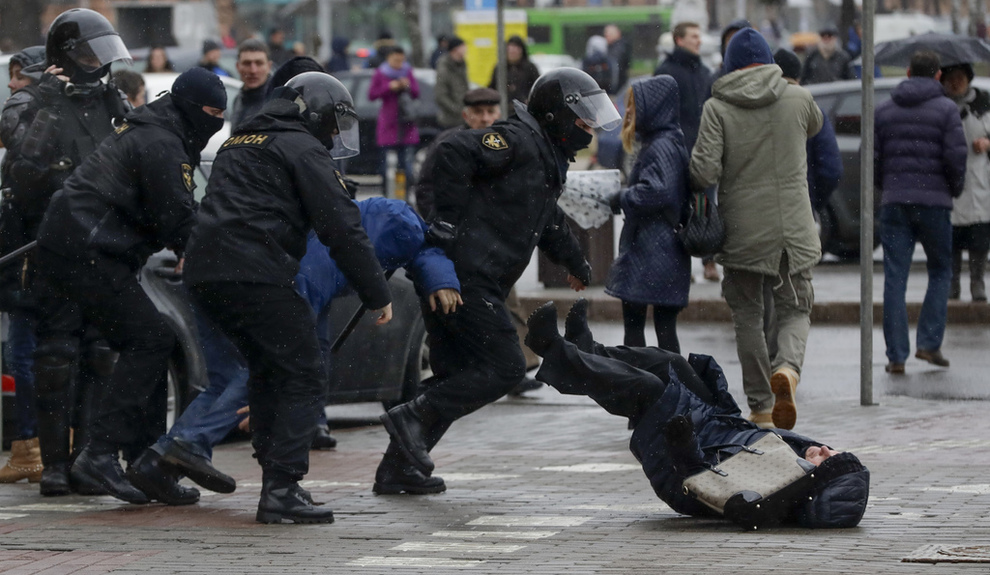
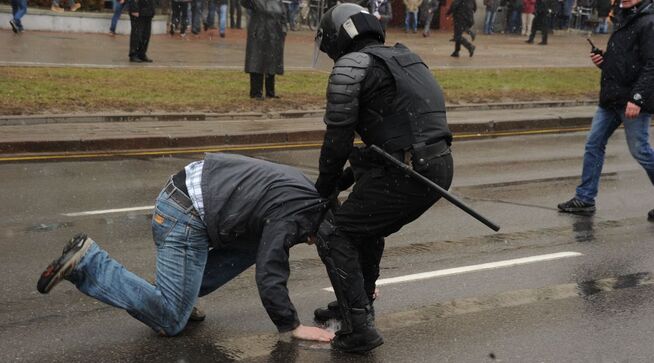
<p>HARDHENDT: Hviterussiske spesialstyrker brukte, ifølge Amnesty og andre menneskerettighetsorganisasjoner, harde midler da de slo ned mot fredelige demonstranter i Minsk lørdag. Politifolkene hadde utstyr som opprørspoliti pleier å bruke.</p>
HARDHENDT: Hviterussiske spesialstyrker brukte, ifølge Amnesty og andre menneskerettighetsorganisasjoner, harde midler da de slo ned mot fredelige demonstranter i Minsk lørdag. Politifolkene hadde utstyr som opprørspoliti pleier å bruke.
Foto: Sergei Grits, AP
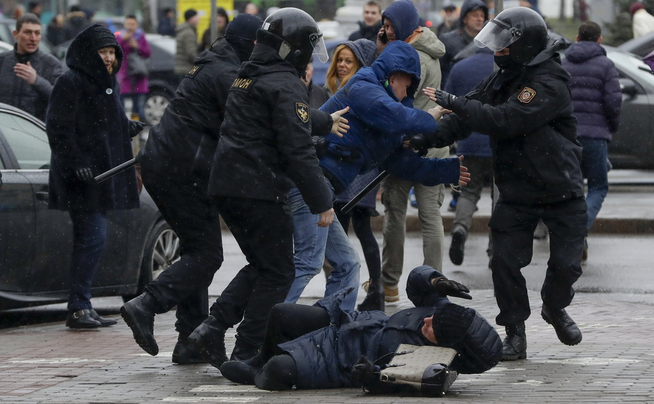
Den hviterussiske presidenten Aleksandr Lukasjenko brukte spesialstyrker mot fredelige demonstranter lørdag.
Bilder fra Minsk viser at soldater fra spesialstyrken OMON gikk til med hard hånd mot demonstranter lørdag. Selv pensjonister med stokk ble tatt inn i politiets beryktede lastebiler. Det var også sivilkledde agenter fra KGB på plass.
Hundrevis av mennesker er pågrepet, ifølge nyhetsbyrået Reuters.
– Hviterussland blir aldri det samme etter denne dagen, skriver menneskerettighetsaktivisten Igor Rynkevitsj på Facebook.
– Mer enn 400 mennesker ble pågrepet. Mange av dem ble slått og trenger medisinsk hjelp, sier Tatsyana Revyako fra den hviterussiske menneskerettighetsgruppen Vyasna (Vår) til Radio Free Europe.
Ifølge Amnesty brukte politiet «overdreven makt» mot fredelige demonstranter.
<p>«DAGDRIVERE»: Protestene i Minsk lørdag var opprinnelig mot en ny lov som gjør at de som jobber mindre enn halve året, må betale en straffeskatt. Men det utviklet seg etter hvert også til en protest mot president Aleksandr Lukasjenko.</p>
«DAGDRIVERE»: Protestene i Minsk lørdag var opprinnelig mot en ny lov som gjør at de som jobber mindre enn halve året, må betale en straffeskatt. Men det utviklet seg etter hvert også til en protest mot president Aleksandr Lukasjenko.
Foto: Sergei Gapon, AFP
Hviterussland kalles av mange for «Europas siste diktatur». Aleksandr Lukasjenko har sittet som president helt siden 1994, og den tidligere kollektivfarm-sjefen har tydeligvis ingen planer om å gi fra seg makten.
Demonstrasjonene lørdag var opprinnelig ikke rettet mot ham, men mot den såkalte «parasittskatten» som hviterussiske myndigheter har innført. Den slår fast at alle som ikke har hatt jobb og betalt skatt mer enn halve året (183 dager) må betale en straffeskatt på cirka 2000 kroner. Det er en stor sum for fattige hviterussere.
– Dette har vært smertens dag, skriver nevnte Rynkevitsj, og fastslår at den siste respekt for Lukasjenko nå er borte. Menneskerettsaktivisten krever at presidenten må for retten, men er tydeligvis ikke så optimistisk for det:
– I hvert fall i historiens eller himmelens domstoler, skriver han på Facebook.
<p>DRAMATISK: En kvinne prøver å beskytte seg mens hun ligger på bakken, mens hviterussisk spesialpoliti pågriper en mann under lørdagens demonstrasjoner i hovedstaden Minsk.</p>
DRAMATISK: En kvinne prøver å beskytte seg mens hun ligger på bakken, mens hviterussisk spesialpoliti pågriper en mann under lørdagens demonstrasjoner i hovedstaden Minsk.
Foto: Sergei Grits, AP
Komsomolskaja Pravda melder at en av de mest kjente opposisjonspolitikerne, Vladimir Nekljajev, ble pågrepet natt til lørdag. Han skulle opprinnelig ha talt på et protestmøte lørdag.
Poeten Sabina Brilo skriver på Facebook at helt vilkårlige mennesker kan ha blitt arrestert, og at det er viktig at de nå skaffer seg en oversikt.
Hennes mann Andrej Bastunets mener at hundrevis av mennesker er pågrepet.
– Jeg så hvordan soldatene tok en ung gutt og begynte å slepe han mot en ventende buss. Da de andre demonstrantene prøvde å hjelpe ham, begynte soldatene bare å pågripe alle som de så omkring seg. De slo folk, drog dem inn i bussen og fortsatte å slå dem inne i bussen, sier Bastunets til dn.se. Han er leder i det uavhengige hviterussiske journalistforbundet.
Både lokale og internasjonale journalister skal være blant de pågrepne.
Se grafikken: Slik omringer Putin Ukraina
– Det er som en krigssone i Minsk. Politiet er overalt, sier Ena Bavcic fra organisasjonen Civil Rights Defenders til nyhetsbyrået TT.
President Lukasjenko sa tidligere denne uken at demonstrantene er «femtekolonister» med støtte fra vesten og vestlige etterretningstjenester. Han sa at titalls mennesker var pågrepet allerede før denne dagen.
I motsetning til for eksempel Russland, har Hviterussland beholdt navnet KGB på sin etterretningstjeneste, det samme navnet som på det beryktede sikkerhetspolitiet i Sovjetunionen.

Kilde: http://www.vg.no/nyheter/utenriks/hviterussland/spesialstyrker-mot-demonstranter-hviterussland-blir-aldri-det-samme-etter-dette/a/23958916/

lørdag 25. mars 2017

Minsk today

More money for Lukashenka's regime - more these beautiful cars for Belarus!

 http://www.racyja.com/hramadstva/dzen-voli-u-mensku-2/


Lenge Leve Belarus!


onsdag 22. mars 2017

Night detentions. Who are Lazouski, Yaudaukha and Dundukou?

Miraslau Lazouski, Ales Yaudakha, Andrei Dundukou. Photo: lit-bel.org, movananova.by, budzma.by
In the afternoon on March 21 Aliaksandr Lukashenka said that Belarusian special services had destroyed a camp for militants' training in a forest between Asipovichy and Babrujsk. According to the head of state, several dozens people were detained. The news broke as a bomb...and a huge surpise: KGB, Interior Ministry and Prosecutor's Office are yet to release a comment.
Already in the evening, arrests began in Minsk - they were seemingly not connected. Miraslau Lazouski, the former leader of Bely Legion [an underground pro-Belarusian independence sport and patriotic organization] was the first to get detained. In the 2000s, the organization seized to exist. Currently, Lazouski has a publishing business.
According to Lazouski's friend Nina Shydlouskaya who coordinates the Budzma! civic campaign, she lost contact with him at approximately 1900 on March 21 when he left the office. The detention took place in central Minsk in Mayakouski street. Lazouski was reportedly beaten. When he was brought home at around 2000 to search his apartment, there was blood on his head and the hands cuffed, according to Shydlouskaya
"Bely Legion"(White Legion) is a sport and patriotic organization, which operated underground in Belarus in the 1990s. It was founded on the youth wing DRAB (Regional Security Guard) but liquidated by the authorities Belarusian Union of Officers. In 1996-1999, Bely Legion comprised approximately 200 people. They participated in all major opposition-staged street rallies in the late 1990s. After 1999, the organization halted operations, with some of the members switching to business and some working as guards for opposition leaders. The last time Bely Legion was mentioned was in 2008 when the former leaders of the organization Ihar Korsak, Miraslau Lazouski and Siarhei Chyslau were detained in connection with the investigation of the explosion on July 3, 2008. They were shortly released.
The next detention aslo took place in the center of Minsk. Book trader Ales Yaudakha was detained by unidentified men when he stepped out of CECH art center after the literary awards ceremony. He was detained at approximately 2200.
Yudakha's apartment was searched for the whole night. According to Euroradio, the security officials paid attention to the maps of BSSR and Minsk region, a book on the combat tactics, cash money (local currency, US dollars and euros), souvenir fan stickers and chevrons of the battalions fighting in Ukraine. The book trader is accused of organizing and preparing the large-scale unrest.
Ales Yaudakha is a prominent Belarusian book distributor, founder of the Books via Post website. Yaudakha specialized in the distribution of Belarusian-language literature - something not liked by the authorities. In 2011, the trader was detained and accused of illegitimate entrepreneurship. In July 2012, he was sentenced to one year of restricted freedom and ordered to pay $6500 in losses to the state. Yaudakha remained in the business.
In the morning of March 22, a third person and a former Bely Legion member Andrei Dundukou was detained. Most recently, Dundukou worked at the Ministry for Emergencies. "He was detained at night at the border with Ukraine when driving with his wife, child and a friend. The friend was detained and the car confiscated. The wife and the child had to hitchhike and reached home in Minsk at around 6 in the morning," Nina Shydlouskaya told Euroradio.

What do these arrest mean?

Political commentator Andrei Parotnikau reckons that after Lukashenka's statement Belarusian security officials found themselves in a situation when they had to provide justification for the result. “When the result is announced that dozens militants were detained, security services had to find those militants. Therefore, the system began to work. They have opened their databases and picked the persons who, in their view, are inclined to extremist or violent actions - that's it. I think more detentions will follow,” thinks Parotnikau.
According to unconfirmed reports, one more Legion member who now serves in law-enforcement was detained in the night of March 22. Euroradio will follow these developments. Stay tuned.

Сleanup before Freedom Day: Belarus authorities arresting all available activists (UPD)

The Belarusian authorities have apparently decided to neutralize Belarusian activists in the run-up of the Freedom Day march on March 25. 
Moreover, brutal arrest of the people for unknown reasons began after Lukashenka’s statement that gunmen with weapons who were preparing a provocation had been detained in Belarus.
20.39 Minsk: Civil activist and co-founder of the youth organization Zubr Yauhen Afnagel has been detained on Wednesday evening. His flat is being searched.

Homiel
The police attempted to break in Mikalai Peshkou’s flat; as of 21.30, the activist is at liberty;
A protocol was drawn upon Andrey Makarau; the activist is facing trial;
In addition to a fine and 10 days in jail, another protocol was drawn upon Uladzimir Nyapomnyashchykh;
Maxim Filipovich who has been hungerstriking for 9 days will be tried tomorrow;
Artsyom Shaporau was summoned;
Plainclothes policemen are constantly on the watch near the block of flats where activist Andrey Strizhak lives. He was tried in absentia and sentenced to 10 days in prison.

Belsat TV contributors Volha Davydava and Lyubou Luniova were detained in Minsk.The women were present at the meeting for journalists held by activist Nasta Dashkevich whose husband was arrested a few hours earlier. Then they went to Leninski district police department, where, according to preliminary information, arrestees Zmitser Dashkevich and Artsyom Leuvchanka might be kept. The journalists and Nasta Dashkevich were detained for ‘filming in a security facility’, their smartfones were siezed. At the same time, they did not film anything, the women state.
(UPD) After searching, the police released them.

On March 22, the Minsk police arrested former political prisoner Zmitser Dashkevich and activist Artsyom Leuchanka who were assembling kitchen furniture in the flat of the famous Belarusian historian and writer Uladzimir Arlou.
(UPD) They are reportedly being kept in the KGB prison in Minsk.

“[Kurapaty defender] Syarhei Palcheuski took our car to carry necessary tools. They must have arrested him when he drove back. Perhaps, he decided not to get out of the car. Its side windows are broken, the car is opened, we don’t know where Syarhei is,” Zmitser Dashkevich’s wife Nasta says.
“I saw a crowd of unknown people; Zmitser Dashkevich and Artsym Leuchanka were facing the wall. When I asked what had happened, I was told that at my place bad workers had worked – they had knocked the kitchen door, so they [police] came to detain them. I said I had not called the police. And he stopped talking to me,” Arlou’s wife Valyantsina Aksak told Belsat.eu.

Pinsk-based activist Dzmitry Serhiyevich was sentenced to 5 days in jail for calling to participate in the ‘non-parasite’ rally on March, 11.
In Baranavichy, activists Ryhor Hryk and Mikalai Charnavus were tried for participating in protests.
In Hrodna, several civil activists were summoned to Leninski district court over their taking to the streets during the march of ‘non-parasites’ which was held in the city on March 15.
Pinsk-based freelance journalist and Belsat TV contributor Viktar Yarashuk was detained on the street at about 10:00: two plainclothes men ordered him to go to the police station.
After a while, the police drew up a protocol on the journalist for ‘illegal production and distribution of media products’ and took him to court where Yarashuk was BYN 920 fined (appr. €450).

Activist Ales Mekh, a resident of Kobryn, was detained, he said on Facebook. Now his telephone is out of reach.

Natallya Papkova, one of the organizers of ‘non-parasite’ marches in Brest, has been detained at the railway station. She was going to participate in the rally on March 25 in Minsk. Human rights activists consider it a preventive detention. At 14:00 the hearing of her case started in Leninski district court. But it is still unknown why she was detained.
In Dobrush, Belsat TV contributor Kastus Zhukouski was detained. He was taken to a local police station for investigation, but released without drawing up a report.
Meanwhile, Homiel-based freelance journalist Andrey Tolchyn was contacted by the local police and told he would be summoned. The man is facing trial now. “But I have no idea what they will accuse me of – I have not broken any laws,” he says.

fredag 17. mars 2017

Policemen without uniform' assaulting citizens in Belarus, protestors claim

Belarusians protesting against their government’s proposed "tax on spongers" have been forcefully detained by men in civilian dress, social and local media appears to show.
Men wearing dark hats and coats were seen dragging people into minibuses without number plates on Wednesday evening, according to videos published on Twitter and by Radio Svoboda, a media organisation funded by the US State Department.
Twitter users claim that the men carrying out the violence are policemen not wearing uniform.
It is unclear whether the people being assaulted participated in the sanctioned protests, which were attended by 2,000 people in Minsk and hundreds more in other towns, according to Radio Svoboda.
In one video filmed from inside a bus, passengers try to stop a man from being manhandled and pulled off.
It has been reported that 160 people have been detained since the start of March.
Despite the alleged clamp down on peaceful protesters, President Lukashenko, often referred to as Europe’s last dictator, said on Thursday that “Belarus is a European country. And here there are human rights, rule of law and democracy just like in Europe.”
Belarus has seen a series of demonstrations since February, when hundreds of thousands of Belarusians received a tax bill of $245 for being classified as "social parasites" under a presidential decree ‘On the Prevention of Social Dependency’.
The decree targets citizens who have not worked in the past six months and not paid tax.  Penalties for not paying the tax include compulsory community service, which Amnesty International believes may amount to forced labour.
The average monthly salary in Belarus is around $380.
Mr Lukashenko last week bowed to public pressure and delayed this year’s tax until next year.  But protesters, who claim the jobless tax is unconstitutional, are calling for the measure to be abolished.

Kilde:  http://www.telegraph.co.uk/news/2017/03/16/video-footage-shows-policemen-without-uniform-assaulting-citizens/

lørdag 25. februar 2017

Kurapaty defender chains himself to truck (live stream)

One of the participants of the “watch” at the Kurapaty memorial construction site, Syarhei Palcheuski, lay under the wheels of the truck and handcuffed himself to the bumper.
(UPD) Three hours later, masked men in the uniform of the Emergency Ministry came, cut the handcuffs and attempted to take him into their bus. The protesters prevented them from detaining Palcheuski.
Syarhei Palcheuski

 ‘I will lie here, until I die,” said Syarhei Palcheuski.
The man said that he understood that he had taken a radical step, but saw no other way to stop the construction.
The activist lay down on wet and cold ground wearin a raincoat, but he agreed to a rubber mat put underneath, “Radio Svaboda” reports. Palcheuski refused other assistance from those present, even warm tea.
The workers are standing near, Palcheuski’s act raised a smile. One of them insulted the activist saying that “if necessary, he would start the car”.
belsat.eu, Svaboda.org

fredag 17. februar 2017

March against ‘parasite’ decree held in Minsk


The last day of tax payment is February 20th. In the meantime, about
10% of “parasites” out of 460 thousand people singled out by the state
have paid the tax. Among the ‘parasites’ are migrant workers, students,
women on maternity leave, pensioners, people with disabilities, and even
the dead.


Many of them took to the street tonight. They gathered on the Kastrychnitskaya Square in the center of Minsk.


Several Belarusian opposition politicians were present at the
gathering. Pavel Sevyarynets, on 15 February who passed the results of
the initiative for the abolition of the decree on “parasites” to the
Presidential Administration.The survey was conducted by belsat.eu on its
page in social networks.


According to some estimates, several thousand protesters gathered on Kastrychnitskaya Square.


People chanted “Solidarity” and marched along Independence Avenue, heading towards the Ministry of Taxes and Duties.


The march took place to the sounds of hits from the bands like ‘Brutto’. with protesters singing along.


Mikola Statkevich, another prominent Belarusian activist, said that
if within a month the Decree N3 is not canceled the rally will repeat.


The rally lasted approximately 1.5 hours.


 http://belsat.eu/en/news/march-against-parasite-decree-held-in-minsk-photo-video/


belsat.eu

lørdag 11. februar 2017

Dalia Grybauskaitė: ‘West-2017’ military drill worrying

Lithuanian President has spoken about the Belarusian-Russian military exercises to be held this year.
Ms Grybauskaite believes that the “West-2017” excercises demonstrate the preparation of Belarus and Russia to the war with the West.
“We see various threats, they are increasing, we are also anxious about the “West-2017″ drill, where numerous aggressive forces concentrate. It is a open preparation for war with the West,” said the Lithuanian President, talking with reporters in Riga.
According to Dalia Grybauskaitė, the threat from the East has forced the Baltic countries to ask partners for additional security guarantees, such as more rapid decision-making in NATO.
On February 9, the Head of Lithuanian Seimas Committee on National Security and Defence Vytautas Bakas said that the “West -2017” military exercise, apparently, will be the largest drill in the history held at the Lithuanian borders. In turn, Director of the State Security Department of Lithuania Darius Jauniškis said that these exercises will be a major challenge to the national security of Lithuania.
belsat.eu,  Ru.delfi.lt, photo Reuters, Ints Kalnins/ Forum