Sider

onsdag 14. august 2013

Family confirms kidnapping of Moldovan and Belarusian nationals in Syria

Family confirms kidnapping of Moldovan and Belarusian nationals in Syria
Two women from Belarus and Moldova were kidnapped more than a week ago.
A video of the women calling themselves citizens of Belarus and Moldova Sviatlana Markiyanavich (Svetlana Markiyanovich) and Karina Koltso and saying they had been taken captive by Syrian rebels appeared on YouTube on August 9. They stand surrounded by masked armed men and read from a paper they arrived in Syria under the guise of journalists to work for Hezbollah. Many think the video was staged.
As for the Belarusian woman, there is an account of Sviatlana Markiyanavich on Odnoklassniki social networking website. The person in the pictures and on the video appears to be the same. Sviatlana Markiyanavich, 30, lived in the town of Zhodzina. Her last visit to the account was on June 17, 2013. One of the photos shows her against the background of a plane's window. No more details were found on her Odnoklassniki account.
Radio Svaboda journalists obtained more information about the other woman, Moldovan citizen Karina Koltso.
Her brother Leodnid Bydko said she had gone abroad to work on July 25.
“She called me a week ago and said she had been kidnapped. I said I didn't know what to do. She then said I should contact the woman who had sent her there. I asked how it happened. She said she had been kidnapped while she was at her friend's. Both women are held captive.”
She made the first phone call from a Lebanese number. Her second call was made from a Syrian number. She said she was in Syria.
Karina Koltso, 32, doesn't have family, children and a stable job. Her brother has not informed the police yet.
The Ministry of Foreign Affairs of Belarus is examining the circumstances of how a video showing a woman who says she is a Belarusian national taken captive in Syria appeared on the internet.
http://www.youtube.com/watch?v=hGWpRiF69iw

 Kilde : http://charter97.org/en/news/2013/8/14/73889/

fredag 9. august 2013

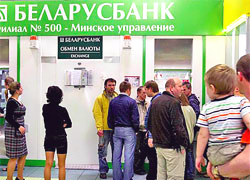
Official economists suggest devaluation


Official economists suggest devaluationIt would have sense to carry out a soft gradual devaluation of the national currency.
This opinion was expressed by Viktar Pinihin, the first deputy director of the Economic Research Institute of the Ministry of Economy, in his article published in the July issue of Economic Bulletin, BelaPAN news agency reports.
Pinihin notes “a rather fast appreciation of the ruble real exchange rate (the inflation rate is far higher than the devaluation rate)”.
“As a result, Belarusian goods are losing the competitive advantages gained after the 2011 ruble devaluation. On the other hand, the National Bank continues to buy foreign currency in the currency market in order not to allow excessive appreciation of the Belarusian ruble,” Pinihin wrote in his article.
The economist thinks that measures taken by the National Bank allow replenishing the country's foreign currency and gold reserves.
“For increasing competitive abilities of Belarus's economy it seems reasonable to carry out a soft gradual devaluation of the national currency in the short term on the basis of supplying the growing demand for the foreign currency by the state given that the state really needs it,” the first director of the Research Economic Institute says.
The devaluation rate should be tied to the Russian ruble depreciation, the economist suggests.
“It is possible to be guided by the index of the Russian ruble devaluation against the dollar that has been carrying out by Russia since the beginning of the year to protect its national market after the WTO accession (instead of the tariff protection) and increase price competitiveness of Russian manufacturers in the international market,” Pinihin supposes.

Kilde :  http://charter97.org/en/news/2013/8/8/73582/

Signature for white-red-white flag to be filed to Ministry of Culture


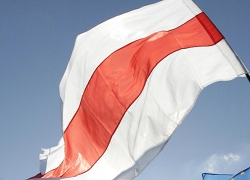
Signature for white-red-white flag to be filed to Ministry of CultureOne thousand of signatures for including the national white-red-white flag in the Cultural Heritage List of Belarus will be filed to the Ministry of Culture today.
The campaign to collect signatures was launched on June 5 by BMAgroup, Art Siadziba and Rock Solidarity groups, Radio Svaboda reports.
Pavel Belavus, Art Siadziba director and initiator of the campaign, says about 60 people sent signature sheets from all Belarusian regions. Most signatures were collected in Minsk, but people from Dziatlava, Cherven, Maladzechna, Vileika, Kletsk, Mahilou, Vitebsk, Homel and other towns joined the campaign.
Rock Solidarity group released the CD “Symbol of belief and freedom”.
The petition was signed by about 1,000 people. Signature sheets will be handed over to the Ministry of Culture and their copies will be submitted to the department of archives and record management of the Ministry of Justice and the President's Administration.
The petition calls to “reconsider the question of adding the white-red-white flag to the Cultural Heritage List of Belarus or give another status to the national relic, which currently doesn't have any status.”
Campaign initiators remind the authorities that the white-red-white flag has an long history and had been the state flag of Belarus in 1991-1995.
“Adding the white-red-white flag to the Cultural Heritage List of Belarus or giving it another status will facilitate reconciliation, mutual understanding and peace in the country,” the authors say.
The Ministry of Culture replied to a similar appeal in 2010. Officials said the white-red-white flag couldn't be included in the Cultural Heritage List, because the flag had became a symbol of the Belarusian People's Republic on proposal of BPR state secretary Klaudzi Duzh-Dusheuski only in early 1919.
Campaign organisers decided to remind the authorities that the first president of Belarus swore in under this flag.
“If it is not recognised cultural heritage, we may cross out the first years of Belarus's independence, when it was the state flag,” Pavel Belavus thinks.

Kilde :  http://charter97.org/en/news/2013/8/8/73604/

onsdag 7. august 2013

Aksjonene for støtte til politiske fanger i Hviterussland

4 august kom medlemmer av "Union for demokrati i Hviterussland" til den hviterussiske ambassaden i Berlin og hang der portretter av hviterussiske politiske fanger. Det gjøres hvert år for å sette fokus på ansikter av Eugene Vaskovich og Artem Prokopenko som ble dømt til sju års fengsel for å forsøke å sette fyr på døren til Bobruisk avdeling av KGB- fortalte  Anatol Michnaviec lederen av "Union for demokrati i Hviterussland" i Polen til Euroradio.
I tillegg til Vaskovich og Prokopenko ble det også nevnt menneskerettighetsaktivisten Ales Bialiatski og hviterussisk flyktning i Polen Andrei Zhukavets.


 På samme dag besøkte representanter for organisasjonen i Stavanger monumentet "Sverd i fjell". Ved siden av den hang de også portretter av politiske fanger i Hviterussland og en hvit-rød-hvitt flagg.
Aksjonene ble holdt til Day of Solidaritet med hviterussiske sivile samfunn.


Samme aksjon ble holdt i Warszawa i Polen av medlemene i den "Union for demokrati i Hviterussland" og andre organisasjoner. 

Kilde :   http://euroradio.fm/pra-belaruskih-palitvyaznyau-zgadali-u-nyamechchyne-i-narvegii-fota00

Bilder fra : http://racyja.eu/ 

http://euroradio.fm/pra-belaruskih-palitvyaznyau-zgadali-u-nyamechchyne-i-narvegii-fota00

 http://www.svaboda.org/content/article/25065897.html

fredag 19. juli 2013

Iryna Khalip: I do not feel as a free person yet


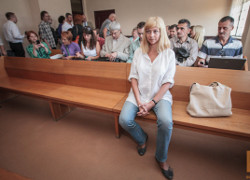
Iryna Khalip: I do not feel as a free person yetAny former political prisoner can get behind the bars again.
A journalist Iryna Khalip shared such an opinion in an interview to the charter97.org web-site after today’s trial.
“I do not feel as a free person yet. I do not yet understand how it is possible not to check the time at night, do not understand how it is possible to go, for example, to a theater or concert in the evening and know that even if you are back later than 10 p.m., nothing bad will happen. I do not yet understand how I can get on a train or a place and go somewhere without asking someone for permission. De-facto, I was under house arrest all the time like Uladzimir Niakliajeu. If we add the five-month jail term, then we get quite a long term. I would also like to say that a person cannot be free even if the person is not currently under arrest or criminal persecution Remember how people met Parfiankou and Jaromienak, who came from prison as free people. Now Parfiankou is preparing to go to prison again”, - the journalist noted.
She highlighted that we cannot in fact feel free, because the state machine may introduce any moment.
Dzmitry Dashkievich will soon be released, because his prison term expires, but they will say that the situation has improved because Dashkievich is released. One must not confuse logic. Now the number of political prisoners is again increasing. That I have not been sent to a colony today does not mean that this will not happen in a month or two or in a year on a new criminal case. This does not mean that Uladzimir Niakliajeu will also be released. I still do not believe in any improvement”, - the former political prisoner says.
She added that she did not hope for anything when she went to the court.
“In these years I have been able to develop such an ability – not to expect anything, not to plan anything. Let it be as it will. So far I have plans for the nearest evening. Together with friends we are going to meet and go to some café and not to check the time”, - Iryna Khalip said.
We would remind that the court of Minsk’s Partizan district decided to free the journalist Iryna Khalip from the criminal punishment as the verdict’s postponement expired.
On 16 May 2011 the wife of a former presidential candidate Andrei Sannikov was sentenced to two years in prison with a postponement of the punishment for two years.
Photo: euroradio.fm
Kilde :  http://charter97.org/en/news/2013/7/19/72470/

lørdag 6. juli 2013

Tsjekkia har offisielt anerkjent hviterussere.


På onsdag den 3.juli har den tsjekkiske regjeringen anerkjent hviterussisk nasjonal minoritet i landet og besluttet å oppnevne representanter for dette samfunnet til Statens råd for nasjonale minoriteter.
Minoritetsstatus vil automatisk kvalifisere for statlig støtte og tillater de etniske minoritetene i Tsjekkia å utvikle sin kultur, tradisjoner og språk. Den offisielle statusen gir minoritetene lov til å bruke sitt språk i offisielle institusjoner og domstoler, og ha egne skoler med opplæring på hviterussisk.

Minoriteter må oppfylle to grunnleggende forhold: deres samfunn må ha historisk tilknytning til Den tsjekkiske republikk og ha nok medlemmer med tsjekkisk statsborgerskap.
"Vår folkeforening" Pagonja " har jobbet med saken i de siste tre årene. Det var en stor historisk analyse med støtte av tsjekkiske historikere. «Erkjennelsesprosessen var ikke lett, men vi har endelig gjort det,» sa forenings medlem Vitaly Timosjchenko. De fikk støtte fra utenriksminister, Karel Schwarzenberg og kommissær for menneskerettigheter, Monica Shymunkavay. Adam Kalita skal offisielt representere den hviterussiske folkeforening, "Pagonja".

 Hviterussere har hatt bånd til de tsjekkiske landområdene siden det 16. århundre. Mange har flyktet dit fra den russiske revolusjon i 20-årene av forrige århundre. Den andre store utvandringen skjer i løpet av de siste tjue årene. Nå er det offisielt registrert flere tusen hviterussere i Tsjekkia. De kommer hit hovedsakelig av økonomiske og politiske grunner. En stor del av det hviterussiske samfunnet i Tsjekkia er studenter.

tirsdag 2. juli 2013

Istanbul resolution for Lukashenka

Istanbul resolution for LukashenkaA resolution on Belarus has been adopted at a session of the OSCE’s Parliamentary Assembly in Istanbul.
The Parliamentary Assembly of the OSCE called on Belarus to immediately and unconditionally release and discharge all the political prisoners, including probationers and persons, limited in their freedom, and also ensure the full recovery of their civil and political rights. These are the points of the resolution on the situation in Belarus, adopted on 2 July at a session of the PA Democracy, Human Rights & Humanitarian Questions, BelaPAN reports.
The Parliamentary Assembly of the OSCE has again called upon the government to allow representatives of the PA to visit the political prisoners in Belarusian prisons.
The resolution condemns the treatment of the political prisoners, who are kept in prisons on politically motivated charges and in many cases are deprived of the right for regular meetings with counsels and relatives, and other treatment, humiliating a person’s dignity and equal to tortures.
The Parliamentary Assembly of the OSCE calls upon the Belarusian leadership to cancel any limitations on the movement of the probationers, including the wife of the former presidential candidate Andrei Sannikov Iryna Khalip and a former presidential candidate Uladzimir Niaklajeu.
The document also contains the appeal to official Minsk to restore the licenses of the lawyers, who were deprived of them or had to resign under pressure for protecting oppositionists and civil activists.
The authors of the resolution urge the authorities to stop putting pressure and persecuting the representatives of civil society, in particular youth organizations and movements, trade unions, independent media and human rights activists.
The government is suggested “to consider a possibility of carrying out substantial legislative reforms with the aim of bringing the country’s laws in compliance with European standards, including the elimination of the misbalance in the distribution of power in favor of the executive branch, established by the country’s Constitution of 1996, with especial attention to decreasing the dependence of the judiciary from the executive power”.
The OSCE’s Parliamentary Assembly also urges to abandon the article 193.1 of the Criminal Code (activities on behalf of an unregistered organization).
The resolution contains regrets about the limited cooperation of Belarus’ government with many institutions of the OSCE and also a working group of the PA OSCE on Belarus, which did not receive any invitations to visit the country.
The document notes that human rights violations in Belarus “are still of a systemic and endemic nature, which is visually proven by the centralization of the legislative and executive powers in the hands of the president, whose decrees are the main legislative mechanism in the country, which undermines the role of the parliament”.
OSCE’s Parliamentary Assembly calls upon Belarusian authorities to “follow their obligations within the OSCE regarding the freedom of assembly and the freedom of speech and to liberalize the legislation and practice by the means of providing citizens with a right to express public protest on the Internet and through other channels likewise”.
The resolution states the necessity to cancel all the death penalty verdicts already passed in Belarus and immediately start working on the abolition of death penalty.

Kilde: http://charter97.org/en/news/2013/7/2/71558/