Sider

lørdag 4. januar 2014

World stars support Belarusians in their fight for freedom

British stars put their signatures to support the campaign Fuck Realpolitik.
The campaign was launched by the Belarus Free Theatre and the initiative Free Belarus Now.
The world stars urge the EU leaders to toughen pressure on the Lukashenka regime to free and rehabilitate the political prisoners, investigate cases of politically motivated abductions, abolish the death penalty in the country and release the bodies of executed people to their families.
Eight stars of theatre, cinema and music joined the campaign and signed postcards for the EU leadership.

Sir Tom Stoppard, playwright, script writer, director, Commander of the Order of the British Empire, member of the Order of Merit, laureate of the Praemium Imperiale, Oscar award winner, winner of plenty of theatre and cinema awards.


Stephen Fry, actor, writer, playwright, TV presenter, winner of many cinema, theatre and TV awards.


Ronnie Wood, musician, guatarist, member of the legendary Rolling Stones.


Michael Palin, actor, writer, TV presenter, traveller, one of the members of the comedy group Monty Python, Commander of the Order of the British Empire, winner of four BAFTA Awards, president of the Royal Geographical Society in 2009—2012.


Jude Law, actor, producer, winner of the BAFTA Award, winner of two Oscars, winner of three Golden Globe Awards.


Laura Wade, playwright, script writer, winner and nominee of a number of playwright awards, Olivier nominee.


Rufus Sewell, theatre and film actor, winner and nominee of a number of theatre and cinema awards, BAFTA, Olivier and Tony nominee.


Freddie Fox, actor, one of the most promising British theatre and film actors, known for his roles in The Three Musketeers, The Mystery of Edwin Drood and Parade's End.


Director of the Belarus Free Theatre Natalia Kaliada, one of the initiators of the campaign Fuck Realpolitik, comments on the step by prominent British cultural figures:
“More than 3,000 people sent postcards to to the EU leaders as part of the campaign. In 2011, twenty cultural figures, including late Vaclav Havel, signed the Artist Manifesto for Belarus saying that artists have no executive powers, but they have a voice that can be heard. The aim of foreign actors with civic awareness is to make politicians of their countries answer both before the Belarusians and their prominent fellow countrymen concerned about human rights violations in Belarus.
The task of us, the people living outside Belarus, is to make people remember about it and wake up those able to help the people under the pressure of the dictatorship.”

Kilde :  http://charter97.org/en/news/2014/1/4/83141/

onsdag 18. desember 2013

Psychiatric hospital for performance

Пэрформанс Алеся Чаркашына ля Берасьцейскага аблвыканкаму
A BCD activist, Ales Charkashyn, was taken to Brest psychiatric hospital.
He was taken to hospital from the Leninski district police department after a permanence on the steps of the regional executive committee building.
This information was received from Zmitser Shukhrai, a coordinator of the organising committee to create the Belarusian Christian Democracy party (BCD) in the Brest region, Radio Svaboda reports.

“I called Brest's Leninski district police department. An officer on duty told me no trial was expected so far, because doctors from the psychiatric hospital showed interest in the activist.
Ales was taken for a psychiatric examination. It may take up to three days. If he is found sane, the police will charge him with holding an unsanctioned action. I think it is a provocation organised by the KGB. It's unlikely that police officers called doctors. It was done to put psychological pressure on Ales and discredit him. I can say that Ales Charkashyn is a normal and adequate person. The action was unusual, but a performance is supposed to be unusual,” Zmitser Shukhrai says.
Ales Charkashyn held a one-man performance on the steps of the Brest region executive committee. The man chained his hands and poured red paint on them. He then delivered a speech to residents and the city authorities.

Ales Charkashyn said Belarus would meet days turmoil, so everyone should turn to God and repent. He called on the authorities to “stop oppressing and robbing people, otherwise they will bear responsibility for the shed blood.”

Kilde :  http://charter97.org/en/news/2013/12/16/81930/

onsdag 11. desember 2013

The Square and Maidan against losers


12:41, Natallia Radzina — Opinion
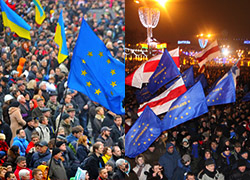
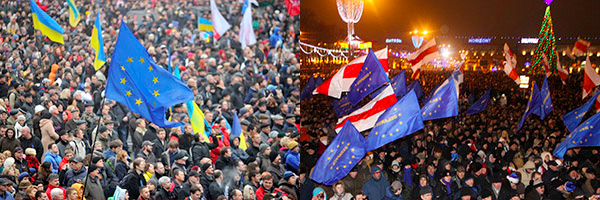
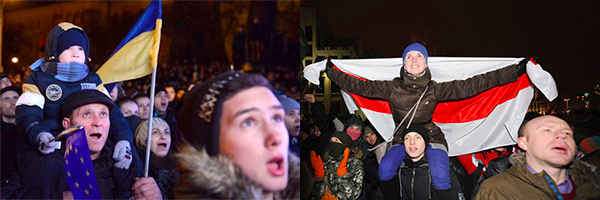
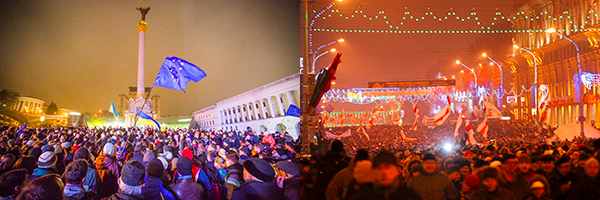
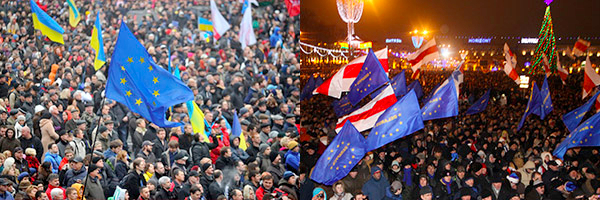
Photos from the Maidan in Kyiv were a déjà-vu.
The Square and Maidan against losersI saw that in Minsk, also in December, but three years earlier, in 2010. The year the dictatorship celebrated its 16th anniversary, dozens of thousands of Belarusians went to the streets to demand changes, despite years of repressions and elimination of all rights and democratic freedoms.
Indeed, we were less than a million, only 50 thousand, but each and every one of us who came to the Square on December 19, 2010, was a hero, because we went there ready for the worst, fully aware of consequences. For all of us this day will be a landmark, personal Red Square-1968, a crucial event in our biographies, a line separating “before” and “after”.
We all came to the Square hoping not to be there alone. Do you remember the famous play by Yevgeny Vishnevsky “What Could I Do Alone?” The act was staged at the students’ theater of Moscow State University in the 1960s during the “thaw”. At first, one person comes out to the stage and asks the audience “What can I do alone?”, then another one comes out and asks the same question, then another one… The number of people on the stage is growing, and suddenly they notice that even though they are many they are still asking the same question.
Then, in December 2010, we saw we were not alone. We became friends, we became one family. There was the spirit of unity, we thought we could smell (and even taste) changes, there was no fear, only hope. And I am convinced that people of Kyiv are feeling the same today at the Euromaidan. Maybe each of them will have their own life afterwards, but today they have one life for them all.
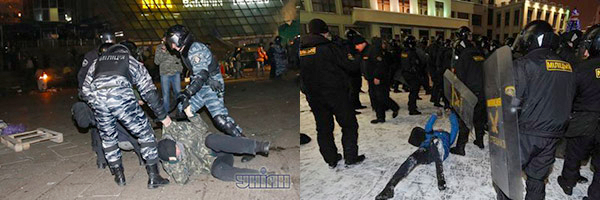
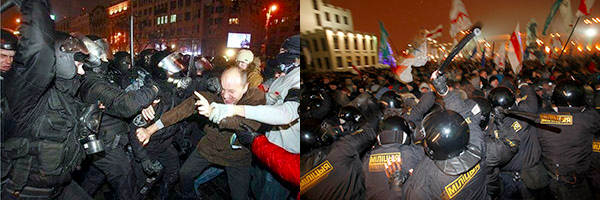
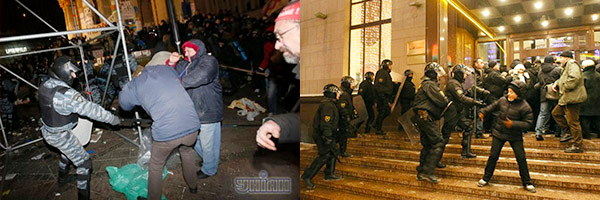
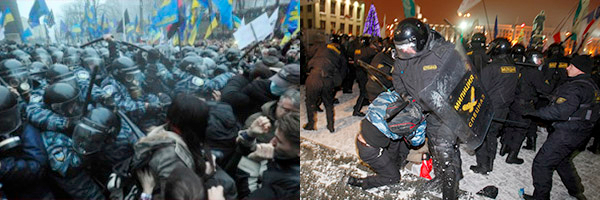
But suddenly darkness fell over the city. Peaceful citizens craving freedom were executed by butchers with faces covered under helmets and masks. The same terrorists in balaclava tortured people in jails the way their predecessors from NKVD did in 1937.
In the KGB prison, we were isolated from the outer world and told just one thing: that everyone forgot about us, that everyone thought of us as of criminals. After my provisional release and prohibition to live in Minsk, before the trial, I understood that it was a lie: first of all, we had support of people of Belarus and hundreds of thousands of people around the world.
There were lots of statements, resolutions, extraordinary parliamentary sessions, even a threat of economic sanctions. Several people were released after this threat. Some of them were placed under a home arrest; some were banned from leaving the country – until the trial, unable to have a normal life. But most of the prisoners, including Lukashenka’s strongest peers who posed a real threat to his power, remained behind the bars.
Nevertheless, the West saw the transfer of some hostages from one prison to another as an attempt to meet its demands. The threat of actual economic sanctions disappeared. But most importantly, the decisiveness to support Belarusians’ aspiration to freedom disappeared, too. This decisiveness was stated in the article Lukashenka is a Loser by Foreign Ministers of Poland, Sweden, Germany and Czech, who claimed that the Belarusian dictator had lost the presidential elections.
But then, looking at the empty streets of the hollow occupied Minsk, Western authorities once again decide to work with the person whom they had publicly called a usurper. Political prisoners have many long years in jail ahead of them, their cries unheard behind the thick walls. Realpolitik has its own rules, people’s memory is short.
People forget the deed of thousands of Belarusians and trample their faith and hope. As for Lukashenka, he is still cleansing the country from any sign of political activity, gradually turning Belarus into a concentration camp, just like his idol Hitler. For that, he gets a prize – the World Championship in ice hockey. I think we all remember the Olympics 1936, planned by Western strategists as a tool to turn Hitler’s Germany towards a civilized path.
It’s not the point however. Today there is a risk that our neighbors, Ukrainians, will be betrayed. The entire world is watching their struggle. There is one million Ukrainians out there, but even so many people are no threat to the regime if the West doesn’t show any support.
“The main difference between Lukashenka and Yanukovich is that the first is a dictator while the latter was elected by his people,” Western politicians say and emphasize how “pointless” it is to demand that the Ukrainian president resigns. Who will sign the association agreement, they wonder?
And here we have it again: working with usurpers. People have been assaulted at the Maidan, offices of opposition parties and media have been attacked, censorship has been introduced on TV, free-thinkers have been arrested. After all that Yanukovich has lost his legitimacy.
An order to assault and arrest the people at the Maidan can come tonight, or maybe tomorrow. Just like in Belarus, the opposition leaders can be sentenced to 5-6 years in prison for “organization of mass disorders.” What can the West use as a counterweight? Statements, extraordinary parliamentary sessions, threats of sanctions that will never become real?
Maybe it’s time to stop dealing with loser-dictators and to start listening to the people who crave freedom and call for solidarity?
I know that the Square will happen again in Minsk, and millions will come this time. Just like they did in Kyiv and Moscow. We will keep coming until we have our victory.
Natallia Radzina, editor-in-chief of charter97.org
Kyiv, December 2013 | Minsk, December 2010
 
 
Kilde :  http://charter97.org/en/news/2013/12/11/81613/

torsdag 28. november 2013

International tribunal is needed today on the situation in Belarus

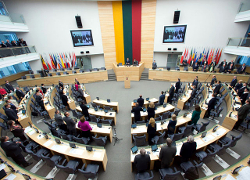
“International tribunal is needed today on the situation in Belarus”Special hearings on Belarus took place in Lithuanian parliament today.
They were timed to the Eastern Partnership summit, which would start in Vilnius, and had the aim of developing recommendations for the European Union and its policy towards Minsk.

The hearings were chaired by the deputy chairman of the Committee on International Relations of Lithuanian parliament Audronis Azhubalis and a parliament member Mantas Adomenas. In the hearings took part the head of the parliament’s Committee on International Relations Benediktas Juodka, leader of the parliamentary opposition and former Prime Minister of Lithuania Andrius Kubilus, relatives of Belarusian political prisoners Natalia Pinchuk, Maryna Lobava, Maryna Adamovich, the mother of the kidnapped journalist Dzmitry Zavadski Volha Zavadskaja, the chairwoman of the Belarusian Association of Journalists Zhana Licvina, the council member of the human rights center Tacciana Raviaka, charter97.org web-site’s editor in chief Natalia Radzina, the director of the Belarusian Human Rights House in Vilnius Hanna Hierasimava, representatives of the political opposition – co-chairmen of the organizational committee for creation of the party Belarusian Christian Democracy Paviel Sieviaryniec and Vital Rymasheuski, the leader of the Just World party Siarhiej Kaliakin, the leaders of Tell the Truth civic campaign Uladzimir Niakliajeu and Andrej Dzmitryjeu, deputy chairman of the Movement for Freedom Aliaksandr Lahviniec, a lawyer of the executive panel of the NGO Assembly Jury Chavusau and the coordinator of Eastern Partnership’s Civil Society forum from Belarus Andrej Jahorau.

The event was also attended by Lithuanian parliament members, the parliament’s ombudsman, representatives of foreign embassies and foundations.
As he was opening the hearings the Lithuanian parliament member Mantas Adomenas stated that human rights should not be forgotten with all the attention going to transit and exports. According to him, Lithuania should be the Europe’s mouthpiece for the Belarusians aiming towards freedom. “What is happening in Belarus reminds of the Soviet Union times”, - he said and emphasized that it is nowadays impossible to imagine that in Lithuania “journalists would be forbidden to tell what they want”. “This is the difference between Lithuania and Belarus. I can hardly imagine for political prisoners to be there in Lithuania”, - Mantas Adomenas claimed.

The leader of the parliament’s opposition Andrius Kubilus noted that the hearings were the indication that the situation in Belarus had not been forgotten. He claimed that sometimes one should actually force themselves to understand that “what is taking place in Belarus, and what people experience in their daily lives, are not just violations of human rights and democracy. There are human tragedies behind these words”. “It is impossible to put up with the current situation in Belarus, but our joint effort is required for that”, - he concluded.

Former political prisoners and relatives of the repressed spoke first at the hearings.
Paviel Sieviaryniec thanked Europe for the principled position on political prisoners. “If it was not for your adherence to the principles I would probably not have been here with you now, because it is only Europe’s firm stance that restrains the incumbent regime from more brutal repressions. Once such a principled position of Europe led to the world’s recognition of the fact of Soviet occupation of Lithuania, Latvia and Estonia”, - he claimed. Paviel Sieviaryniec emphasized that Belarusian political prisoners were hostages in the literal meaning of the word. “The regime keeps holding a critically important number of people, keeps bargaining. At the Belarus’ MFA they do not even hide the fact that there are political prisoners. The EU should proceed with sticking to its principles and insist on their release and exoneration”, - the politician said. He highlighted that another leverage over Lukashenka would be the Ice Hockey World Championship, which is scheduled to take place next year in Minsk.

Then spoke political prisoner Ales Bialiatski’s wife Natalia Pinchuk. She told about the situation, in which her husband is now. According to her, the conditions of his imprisonment have worsened. In the course of last year he did not have any long-term meeting and received only one parcel.
The mother of the disappeared journalist Dzmitry Zavadski Volha Zavadskaja reminded that nothing changed on the case of the kidnapped Belarusians in the past 12 years. “All the terms expire, and we are afraid that the topic of violent disappearances may vanish. It is very important for these crimes, which are crimes against humanity, were not forgotten”, - she claimed.
The wife of political prisoner, former presidential candidate Mikalaj Statkievich Maryna Adamovich shared in detail the latest news on his situation. The conditions have worsened. Maryna Adamovich emphasized that exoneration of political prisoners should remind on the agenda regardless of whether Belarus’ authorities do that or not.

The mother of political prisoner, Young Front’s co-chairman Eduard Lobau Maryna Lobava spoke at the hearings. She claimed that the conditions of her son’s imprisonment might be equated to tortures. “Only economic sanctions, introduced immediately after the events of 2010, helped release many political prisoners. Only owing to targeted economic sanctions, which took place, we now have 10 political prisoners instead of 50. Like before. The release of political prisoners and holding of free and fair elections should be demanded of the Lukashenka regime. After the fulfillment of these demands, one may speak of any dialogue or any cooperation”, - Maryna Lobava emphasized.
The chairwoman of the Belarusian Association of Journalists Zhana Licvina told about the situation with the freedom of speech in Belarus, having noted that the control became total over media. She listed the latest dangerous trends: practice of the use of the extremism law against a publishing house, emergence of such formulations as “activities against the interests of the Republic of Belarus”. She also expressed a concern of authorities’ intention to introduce the obligatory registration for most popular internet information sources.

A human rights activist Tacciana Raviaka told about the situation with Ales Bialiatski and listed the names of all the political prisoners in Belarus, having reminded that another criminal proceeding would start the next day on the case of a youth activist Vasil Parfiankou. This shows, according to her, how vulnerable political prisoners are after being released. “If activists engage in politics, they are immediately subjected to repressions”, -she said. The human rights activists observed that Belarus ignored its obligations in the framework of international organizations: none of the UN’s Human Rights Committee decisions were followed.

Political scientist Jury Chavusau told about the violations of the freedom of association in Belarus. He noted that a number of organizations have not been able to get registered for 10 years. Many are pushed out of the country to go abroad, criminal responsibility keeps existing for acting on behalf of non-registered organizations.

Eastern Partnership Civil Society Forum’s coordinator for Belarus Andrej Jahorau pointed out the problem of EU’s assistance to democratic organizations. He claimed that sometimes programs are implemented with the support of the European Union, which are used by the authorities for persecuting civil society activists.

A co-chairman of the organizational committee for the creation of the party Belarusian Christian Democracy Vital Rymasheuski quoted independent Lithuania’s first chairman of the parliament Vitautas Landsbergis, who said that the export of corruption takes place from East to West, when Western countries start treating dictatorships with pragmatism. The Belarusian politician noted that such an attitude, realpolitik, is being used by Europe in its relations with the Belarusian regime. That is why, according to him, it is time to raise the issue of protecting the democratic values in the EU countries.

The head of the United Civic Party Anatol Liabiedzka reminded that a business forum was taking place in Vilnius that day. “This is where we should have spoken. Probably, Lithuanian businessmen would have had their eyes opened. It would also be useful for them to listen to Vladislav Baumgertner – a businessmen close to the Kremlin, who spent several months in detention in Belarus”, - he said. The politician emphasized that MFA’s head Makej, who would take part in the Eastern Partnership summit, was not a minister at all, but a simple “mailman”, who executes the orders from the dictator.
Uladzimir Niakliaeu stated that Makej was not only a mailman, but an accomplice to the Lukashenka regime’s crimes. According to him, Belarus needed its own Magnitsky list, because the people, who violate human rights, feel their impunity. Uladzimir Niakliaeu noted that visa restrictions alone were not enough for the officials, who carried out repressions.

Movement for Freedom’s deputy chairman Aliaksandr Lahviniec pointed out that Belarus first and foremost needed a European perspective. According to him, this is the only guarantee of a good standard of living in our country.
The leader of the Just World party Siarhiej Kaliakin made a specific suggestion. According to him, there currently were not 10-12 political prisoners in Belarus.

“Those are all the country’s residents. Tens of thousands of people are in prisons, and each one of them is tortured. Gigantic number of people undergoes repressions. The creation of an international tribunal should be initiated on the situation in Belarus”, - he claimed.

Kilde/Source :  http://charter97.org/en/news/2013/11/28/80711/

mandag 25. november 2013

27 november Heroes' Day

Краўцэвіч, Латышонак і Міхнавец заклікалі да агульнанацыянальнай акцыі ў Дзень Герояў

Heros Day i Hviterussland- en dag da det oppstod det væpnet opprøret i Slutsk i den nydannet Hviterussiske folkerepublikken i 1920 mot bolsjevikene.
  Hviterussere!
De kjempet for sin frihet og fedrelandet! De ventet ikke på hjelp fra noen! De ville selv avgjøre egen skjebne! De ga sine liv for Belarus, for oss, for deg!
Nittitre år siden. 27. november 1920, begynte Slutsk opprør. Våre forfedre kom for å kjempe for sitt land - Hviterussiske folkerepublikken.
I kampen side ved side kjempet den Slutsky Grozovskii stick, Slutsk First Brigade Væpnede menn BNR. De fikk også med seg den hviterussiske delen av hæren til general Stanislav Bulak – Balakhovich og geriljagrupper "Grønn Eik ".
Flere tusen opprørere frastøtt i en måned den bolsjevikiske invasjonen. De Siste troppene forlot slagmarken bare i januar 1921. Geriljagrupper har kjempet i noen år etter på.
Vår republikk ble født i blodig dødskamp, men vår hviterussisk indre ånd var gjenopplivet og vil aldri dø. Flere modige menn fra neste generasjoner kom for å kjempe for Belarus.
27 november vil alltid være Heroes' Day .
Derfor oppfordrer vi alle som bærer navnet hviterusser til å feire denne dagen og huske våre helter. Sett et stearinlys i vinduet for å minnes de og vise at vi husker dem.
Lenge leve Belarus!

Беларусы!
Яны змагаліся за свабоду сваю і Айчыны! Яны не чакалі ні ад каго дапамогі! Яны самыя вырашалі свой лёс! Яны паклалі свае жыцці за Беларусь, за нас, за цябе!
Дзевяноста тры гады таму, 27 лістапада 1920 года, распачаўся Слуцкі Збройны Чын. Нашы продкі выступілі на змаганне за сваю дзяржаву — Беларускую Народную Рэспубліку.
У бой рушылі Слуцкі і Грозаўскі палкі Першай Слуцкай Брыгады Стралкоў БНР. Да іх далучыліся беларускія часткі арміі Генерала Станіслава Булак-Балаховіча, якія раней біліся пад Мазыром — Беластоцкі батальён і Смаленскі полк, а таксама партызанскія атрады «Зялёнага Дуба».
Некалькі тысяч паўстанцаў на працягу месяца давалі адпор бальшавіцкай навале. Апошнія атрады сышлі з поля бітвы толькі ў студзені 1921 года. Партызанскія атрады прадаўжалі змаганне яшчэ некалькі гадоў.
Свая Рэспубліка нараджалася ў крывавых муках, але наш беларускі родны дух, які тады ажыў, не згасаў. На поле бітвы ў след за случакамі выходзілі наступныя пакаленні змагароў за Беларусь. 27 лістапада — іхны дзень: Дзень Герояў.
Таму заклікаем усіх, хто носіць імя беларуса, годна святкаваць гэты Дзень, успамінаць нашых Герояў і штогод ставіць у акне свечку. Няхай яе агенчык сігналіць Змагарам, што ў гэтай хаце помняць іх Чын.
Жыве Беларусь!

Алесь Краўцэвіч, Беларускае Гістарычнае Таварыства
Алег Латышонак, Беларускае Гістарычнае Таварыства ў Польшчы
Анатоль Міхнавец, Беларуская Нацыянальная Памяць


Чытаць цалкам http://nn.by/?c=ar&i=118349

lørdag 2. november 2013

Dziady


I Hviterussland har vi en tradisjon Dzjady når vi går i kirke og på kirkegården og ber for de døde. På den dagen lages det en rituell måltid som kan bestå av kutia (spesiell laget grøt), pannekaker, kjøtt, egg og annet. Det må være 7 forskjellige retter. På middagsbordet settes det en ekstra tallerken til de døde og på tallerkenen leger man en bitt av hver rett.  Tallerkenen skal stå på bordet over hele natten. Ifølge troen kommer de døde om natta til å sitte rund bordet i nattas stillhet.
 Denne tradisjonen i sin mest arkaiske formen bevart bare av hviterussere .