
mandag 19. mai 2014

søndag 4. mai 2014
Aleksander Kwasniewski: After Ukraine Putin will seize Belarus, Kazakhstan and Latvia
The Kremlin’s goal is to revive the USSR as much as they can.
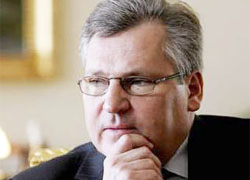 Such an opinion was voiced by Poland’s former president Aleksander Kwasniewski in an interview to PAP.
“Putin is not hiding his intentions. In his statements he touched upon the subject of a “Great Russia”. At the NATO summit in Bucharest in 2008 he claimed that Ukraine was an artificial state. There are also articles by Russian strategists, which say that the borders of the countries within the USSR were marked wrong and the post-Soviet borders should be changed. They claim that this is not only an issue for Ukraine, but also for Kazakhstan, certain regions of Belarus and a part of Latvia. Also remains open the issue of Moldova, Georgia and former USSR republics in Asia. Now we can observe the implementation of that doctrine. One even does not have to resort to intelligence services in order to know that Putin’s goal is a maximum possible restoration of everything that was lost at the collapse of the USSR. Not necessarily by fire and blade, but with a ‘’chaos war”. This means by political means, economic destabilization and the influence via media”, - the politician believes.
We would remind that starting from 6 April Russian subversive groups and local separatists started systematic seizures of administration buildings in towns of Ukraine’s eastern regions. Western media journalists reported that there were Belarusians among the commandoes.
In response Ukraine’s authorities took the decision to launch an anti-terrorism operation in the country’s eastern regions. Troops and equipment were redeployed to Donbas. On 24 April Ukrainian army started the liberation of Slavyansk.
On 29 April separatists seized key administrative buildings in Luhansk – the most eastern regional center of Ukraine. Firearms were used during the storm of the building. The occupants control the regional administration, prosecutor’s office, Ukraine Security Service, Ministry of Interior and the city’s TV and radio center.
Today at 4 a.m. local time law enforcers started taking over the roadblocks around Slavyansk. The terrorists, who have captured the town, report that Ukrainian troops have resumed the anti-terrorism operation. At the moment it is known that Ukrainian army, carrying out an operation to liberate Slavyansk, suffered first loses – two helicopters were shot down.
Kilde : http://charter97.org/en/news/2014/5/2/97005/
tirsdag 29. april 2014
Minsk municipal executive committee banned May Day celebration for trade unions
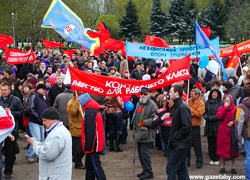 The Belarusian Congress of Democratis Trade Unions (BCDTU)
has been prohibited to hold a meeting on May Day, the International
working-class solidarity Day.
The Belarusian Congress of Democratis Trade Unions (BCDTU)
has been prohibited to hold a meeting on May Day, the International
working-class solidarity Day.The BelaPAN has been informed about that by the chairman of the BCDTU Alyaksandr Yarashuk.
As said by him, the official response of the city authorities, received by the leadership of the trade union on April 28, reads that “outdoor festivities with a concert programme” are to take place at the stage of the Park of Nations’ Friendship on that day.
As said by Yarashuk, the answer was “quite expectable”, as well as “the grounds were quite expectable as well.”
“Fear really has big eyes, so the authorities obviously fear any mass protest rally organized by trade unions,” Yarashuk underlined. “The only conclusion is: as they fear us, things look black, and the social and economic situation is hard. And their grounds are related to the imminent Ice Hockey championship in Minsk as well, I think.”
As the leader of the BDTU said, the Belarusian authorities probably fear that even a supposed mass rally of independent trade unions could trigger disturbances of workers.
“Let it be on the head of the authorities. They are in such a state that they fear their own shadow, let alone an organized rally of workers, representing independent trade unions,” Yarashuk summed up.
Kilde : http://charter97.org/en/news/2014/4/28/96629/
tirsdag 25. mars 2014
Norge mot Belarus

STAVANGER (aftenbladet): Eventbyrået Billettservice har de siste ukene ønsket å selge ekstrabilletter til EM-kvalifiseringen mellom Norge og Hviterussland i Stavanger idrettshall, men Region Sørvest har nå sagt et endelig nei. Hallen er rett og slett full.
 - Vi har
allerede gjort om den ene sittetribunen på kortsiden til ståtribune for å
få inn 1000 ekstra tilskuere. Dermed er antall tilskuere økt fra 6000
til 7000. Da er også ståplassene på langsiden tatt med. Flere mennesker
får vi rett og slett ikke plass til, sier daglig leder i Region Sørvest,
Erik Andersen til Aftenbladet.
- Vi har
allerede gjort om den ene sittetribunen på kortsiden til ståtribune for å
få inn 1000 ekstra tilskuere. Dermed er antall tilskuere økt fra 6000
til 7000. Da er også ståplassene på langsiden tatt med. Flere mennesker
får vi rett og slett ikke plass til, sier daglig leder i Region Sørvest,
Erik Andersen til Aftenbladet.EM-kvalifiseringen mot Hviterussland er håndballjentenes første tellende landskamp i 2014. Norge er i gruppe med Romania og Hviterussland, der de to beste kvalifiserer seg til EM i Kroatia/Ungarn i desember. Og med to seiere mot Romania i boks, er Thorir Hergeirssons jenter allerede kvalifisert. På den bakgrunn er det imponerende at 7000 ser kampen mot Hviterussland onsdag 26. mars.
Både Tonje Nøstvold fra Hundvåg og Camilla Herrem fra Sola er med i troppen, og utgjør de lokale innslagene. Her er hele troppen:
Mari Molid (Levanger), Stine Bredal Oftedal (Issy Paris), Ida Alstad (Holstebro), Heidi Løke (Györ), Tonje Nøstvold (Byåsen), Karoline Dyhre Breivang (Larvik), Silje Solberg (Stabæk), Pernille Wibe (Issy Paris), Linn Jørum Sulland (Larvik), Katrine Lunde (Györ), Veronica Kristiansen (Glassverket), Linn-Kristin Riegelhuth Koren (Larvik), Betina Riegelhuth (Storhamar), Nora Mørk (Larvik), Camilla Herrem (Byåsen) og Sanna Solberg (Stabæk).
Reserver: Kari Aalvik Grimsbø (Esbjerg), Stine R. Skogrand (Tertnes).
Til deg, som var heldig og kjøpte billet : Ta med deg den riktig hvit-rød-hvit hviterussisk flagg!
Kilde : http://www.aftenposten.no/100Sport/handball/Ma-stoppe-billettsalg-til-handballjentene-426305_1.snd#.UzHbWYXgqZF
søndag 16. mars 2014

Kiev's protesters: Ukraine uprising was no neo-Nazi power-grab
On 20 February, as revolution engulfed the centre of Kiev, Joseph Schilling, a 61-year-old builder from western Ukraine, went to the frontline to join the protests against President Viktor Yanukovych's
government. He was standing beneath the neoclassical October Palace –
once a girls' seminary and later the HQ for Lenin's secret police – when
a sniper shot him in the head.
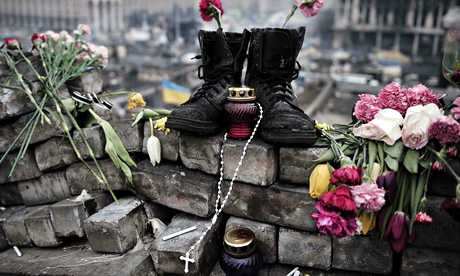
The place where Schilling died is now festooned with flowers. There are carnations, tulips and a tub of spring crocuses. Schilling's photo, near his barricade, reveals a man in late middle age wearing a tie, his hair neatly combed. Here too are images of other members of the "Heavenly Hundred" – the name given to the 102 protesters who have perished near the Maidan, Kiev's central Independence Square.
The Kremlin describes last month's uprising in next-door Ukraine as an illegitimate fascist coup. It says dark rightwing forces have taken over the government, forcing Moscow to "protect" Ukraine's ethnic Russian minority. The local government in Crimea is preparing for a referendum on Sunday which could lead to Russia annexing the region. Yanukovych, meanwhile, has fled to Russia.
Schilling, however, was an unlikely fascist. A father of two daughters, he and his wife Anna had lived in Italy. They had four grandchildren. Moreover, he was Jewish.
 Anti-government protesters lead away a riot policeman in
Independence Square on 20 February, the day that Joseph Schilling died.
Photograph: Reuters
With Ukraine on the brink of invasion and division, most people in
Kiev blame the country's troubles on the former president. "This is
Yanukovych's fault," Zhenia, a pensioner, said, surveying the
battleground in Institutska Street, where many were gunned down. She was
crying.
Anti-government protesters lead away a riot policeman in
Independence Square on 20 February, the day that Joseph Schilling died.
Photograph: Reuters
With Ukraine on the brink of invasion and division, most people in
Kiev blame the country's troubles on the former president. "This is
Yanukovych's fault," Zhenia, a pensioner, said, surveying the
battleground in Institutska Street, where many were gunned down. She was
crying.
Nearby, visitors bowed before makeshift brick shrines, some decorated with gas masks and helmets. Others crossed themselves. One child's drawing said: "Eternal glory to the heroes".
According to those who took part in it, the uprising was a broad-based grassroots movement, launched by people fed up with Yanukovych and involving all sections of society. Some demonstrators were indeed nationalists. Others were liberals, socialists and libertarians. There were Christians and atheists. There were workers from the provinces, as well as IT geeks from Kiev more at home with MacBooks than molotovs.
Its victims were a diverse bunch. The first was an ethnic Armenian; another Russian.
 Mustafa Nayem. Photograph: Francois Mori/AP
The man who began this revolution is Mustafa Nayem, a well-known
Ukrainian journalist. Last November he put a question on Facebook.
Yanukovych had just announced that he was dumping Ukraine's preparations
to sign an association agreement with the European Union. Instead he
was turning to Russia. Nayem – an investigative reporter born in
Afghanistan – asked: was anyone planning to go to the Maidan? "In one
hour my post had more than 1,000 'likes'. That night 400 people showed
up. They stayed until 6am. Most of them were my friends from Facebook.
It was the so-called creative class," he said.
Mustafa Nayem. Photograph: Francois Mori/AP
The man who began this revolution is Mustafa Nayem, a well-known
Ukrainian journalist. Last November he put a question on Facebook.
Yanukovych had just announced that he was dumping Ukraine's preparations
to sign an association agreement with the European Union. Instead he
was turning to Russia. Nayem – an investigative reporter born in
Afghanistan – asked: was anyone planning to go to the Maidan? "In one
hour my post had more than 1,000 'likes'. That night 400 people showed
up. They stayed until 6am. Most of them were my friends from Facebook.
It was the so-called creative class," he said.
This mass street protest went through several iterations, he explained. For weeks it was peaceful. Later, the government used brutal force; in the final hours of the regime, suspected pro-government snipers killed dozens. Eleven police died too.
 Protesters in Independence Square in December, after talks between
opposition leaders and Viktor Yanukovych. Photograph: Etienne De
Malglaive/Getty Images
One of the organisations that participated in the revolution was
Pravy Sektor ("Right Sector"). They are now camped out at the bottom of
the Maidan, in the four-star Hotel Dnipro. Their red and black flag
flies above several of the tents in Kiev's sprawling downtown protest
city; young volunteers – unarmed but wearing khaki fatigues – have
commandeered a boutique and a city council office. The Kremlin points to
Right Sector as proof that what happened in Kiev was an
ultranationalist takeover.
Protesters in Independence Square in December, after talks between
opposition leaders and Viktor Yanukovych. Photograph: Etienne De
Malglaive/Getty Images
One of the organisations that participated in the revolution was
Pravy Sektor ("Right Sector"). They are now camped out at the bottom of
the Maidan, in the four-star Hotel Dnipro. Their red and black flag
flies above several of the tents in Kiev's sprawling downtown protest
city; young volunteers – unarmed but wearing khaki fatigues – have
commandeered a boutique and a city council office. The Kremlin points to
Right Sector as proof that what happened in Kiev was an
ultranationalist takeover.
Right Sector's deputy leader, Andriy Tarasenko, told the Guardian his organisation didn't want to be involved in post-revolutionary party politics. Rather, he said, it sought to "transform the relationship between people and power". What this meant was a little unclear. He also wanted Kiev's new interim government to introduce a law that would allow his members to carry arms. "In Switzerland, everyone has the right to carry a gun," he said. Is Right Sector fascist? "Putin is the fascist. He's the occupier," he replied.
Tarasenko denied his organisation was antisemitic. "I met with the Israeli ambassador. We had absolutely normal relations. We want to trade with Israel," he said. What would happen if Russia went to war with Ukraine, an increasingly likely prospect? "We're ready to fight for our land," he replied. Nearby, on the hotel's fifth floor, a couple of recruits were waiting to join up at a "mobilisation" point.
 Members of the radical group Right Sector practising street fighting in Kiev. Photograph: Darko Bandic/AP
The group's far-right proclivities are obvious. Some of its
footsoldiers dress entirely in black, with military style buzz-cuts.
What is less sure is whether Right Sector amounts to a serious political
force. None of its members died in last month's unrest, fuelling claims
the umbrella movement is guilty of romantic paramilitary play-acting as
well as incoherence.
Members of the radical group Right Sector practising street fighting in Kiev. Photograph: Darko Bandic/AP
The group's far-right proclivities are obvious. Some of its
footsoldiers dress entirely in black, with military style buzz-cuts.
What is less sure is whether Right Sector amounts to a serious political
force. None of its members died in last month's unrest, fuelling claims
the umbrella movement is guilty of romantic paramilitary play-acting as
well as incoherence.
"They're not fascists. They're peasants," the hotel's black Angolan doorman, Claudio Miguel, said witheringly of his shadowy guests. He added: "They don't come from Kiev. They're from faraway villages."
Olexiy Haran, a politics professor and a member of the Maidan's organising committee, expressed exasperation at the way the Kremlin's "fascist" trope had taken root in some western minds. "I've had liberal Harvard professors asking me about this. We are talking traditional Russian propaganda," he said.
Haran characterised the events of the tumultuous past three months as a "national liberation and anti-corruption movement". It was pro-decency, and opposed to a president who behaved "like a puppet of Russia", he said.
In a statement, Haran and other academic experts on post-Soviet Ukrainian radicalism point to the heterogeneous nature of the protest movement – a "confusing mosaic" made up of people with "different motivations, backgrounds and aims". Most of the protesters "only turned violent in response to increasing police ferocity and the radicalisation of Yanukovych's regime," they write.
 Thousands of Ukrainians visit memorials in Independence Square in February. Photograph: Louisa Gouliamaki/AFP/Getty Images
The experts complain of a "dangerous tendency" to misinterpret what
happened. Exaggerated reports of ultra-nationalist actors ultimately
serve "Russian imperialism", they suggest.
Thousands of Ukrainians visit memorials in Independence Square in February. Photograph: Louisa Gouliamaki/AFP/Getty Images
The experts complain of a "dangerous tendency" to misinterpret what
happened. Exaggerated reports of ultra-nationalist actors ultimately
serve "Russian imperialism", they suggest.
For Haran, it has been a bruising few months. Before the uprising, critics of the regime started to disappear, only for their bodies to be found dumped in forests. The professor would take a hammer with him to protests at the Maidan, as well as an orange helmet and a gas mask. (He never used the hammer.)
Sitting at his home in Kiev's high-rise suburbs, he looked exhausted and strung out. He dismissed Sunday's poll in Crimea as a "pseudo-referendum". If Russian troops continued their military advance, Ukrainian forces would have to fight back, he said.
Haran said the rise of "territorial nationalists" – different from ethno-nationalists, who insist on race distinctions – must be understood in the context of Ukraine's recent history. But there is an older backstory too: Stepan Bandera, a hero to Ukrainian nationalists, collaborated with the Nazis during the second world war in an attempt to create an independent Ukrainian state. The Nazis subsequently arrested him and his associates. Moscow has thus dubbed the Maidan activists "Banderovtsy": followers of Bandera.
More recently, Yanukovych's Russification policies set off a counter-reaction and bumped up the popularity of Svoboda ("Freedom") – a radical Ukrainian nationalist party that enjoys support in the west of the country, particularly in Galicia, and polled over 10% in the 2012 elections – winning 38 seats in the 450-strong parliament. Led by Oleh Tyahnybok, Svoboda is now part of Ukraine's government, holding four cabinet positions, including deputy prime minister.
 Oleh Tyahnybok, leader of the radical Ukrainian nationalist party
Svoboda, at an anti-government rally in Kiev in February. Photograph:
Gleb Garanich/Reuters
The party's neofascist past is clear. Founded in 1991 as an
anti-Communist movement, Svoboda was previously called the
Socio-National Party of Ukraine – a nod to national socialism. Its
symbol was Nazi too: a swastika-like Wolfsangel. Tyahnybok dumped the
Hitler paraphernalia when he renamed the party Svoboda in 2004, on
becoming leader. The same year, however, he was ejected from the
mainstream Our Ukraine faction after referring to the "Muscovite-Jewish
mafia".
Oleh Tyahnybok, leader of the radical Ukrainian nationalist party
Svoboda, at an anti-government rally in Kiev in February. Photograph:
Gleb Garanich/Reuters
The party's neofascist past is clear. Founded in 1991 as an
anti-Communist movement, Svoboda was previously called the
Socio-National Party of Ukraine – a nod to national socialism. Its
symbol was Nazi too: a swastika-like Wolfsangel. Tyahnybok dumped the
Hitler paraphernalia when he renamed the party Svoboda in 2004, on
becoming leader. The same year, however, he was ejected from the
mainstream Our Ukraine faction after referring to the "Muscovite-Jewish
mafia".
Over the past decade the party appears to have mellowed, eschewing xenophobia, academic commentators suggest. On Monday, the US ambassador in Kiev, Geoffrey Pyatt, said he had been "positively impressed" by Svoboda's evolution in opposition and by its behaviour in the Rada, Ukraine's parliament. "They have demonstrated their democratic bona fides," the ambassador asserted. Svoboda played a leading role in the revolution; 18 of its members were shot dead. Another deputy prime minister in the new government, meanwhile, is Jewish.
 The sun rises above an anti-government protesters' camp in Independence Square in January. Photograph: Roman Pilipey/EPA
Ukraine's chief rabbi, Moshe Reuven Azman, told the Guardian there
has been no evidence of an antisemitic backlash, either before or after
the revolution. The main synagogue in Kiev, a few hundred metres from
the Maidan, was untouched, he said. Israeli volunteers had treated some
of the wounded. Asked what he thought of Right Sector, he replied: "I
haven't read their programme." He went on: "I've been in touch with
Jewish communities across Ukraine. Nobody told us of antisemitic
statements."
The sun rises above an anti-government protesters' camp in Independence Square in January. Photograph: Roman Pilipey/EPA
Ukraine's chief rabbi, Moshe Reuven Azman, told the Guardian there
has been no evidence of an antisemitic backlash, either before or after
the revolution. The main synagogue in Kiev, a few hundred metres from
the Maidan, was untouched, he said. Israeli volunteers had treated some
of the wounded. Asked what he thought of Right Sector, he replied: "I
haven't read their programme." He went on: "I've been in touch with
Jewish communities across Ukraine. Nobody told us of antisemitic
statements."
Nayem, Haran and others in Kiev argue that the Kremlin's description of a neo-Nazi power-grab is unfounded. A better critique, they say, is that the politicians now in charge are from the same political class that has failed Ukraine in the past, and that the Russian-speaking east of the country – Yanukovych's heartland, bordering Russia – is under-represented.
 Vitali Klitschko. Photograph: Zurab Kurtsikidze/EPA
The new, emergency government is made up of former opposition
politicians from two parties - Yulia Tymoshenko's centre-right
Batkivshchyna and Svoboda. A third opposition party, Udar, led by
former boxing champion Vitali Klitschko, supports from outside. Maidan
activists fill some posts. Yanukovych's Party of Regions, meanwhile, has
disavowed its vanished leader and gone into opposition.
Vitali Klitschko. Photograph: Zurab Kurtsikidze/EPA
The new, emergency government is made up of former opposition
politicians from two parties - Yulia Tymoshenko's centre-right
Batkivshchyna and Svoboda. A third opposition party, Udar, led by
former boxing champion Vitali Klitschko, supports from outside. Maidan
activists fill some posts. Yanukovych's Party of Regions, meanwhile, has
disavowed its vanished leader and gone into opposition.
Ukraine's new prime minister is Arseniy Yatsenyuk – in Washington on Wednesday to meet with President Obama. Yatsenyuk is an English-speaking lawyer and economist. Observers say he is smart, if not exactly charismatic. His chief drawback is that he is a protege of Tymoshenko, who led Ukraine's 2004 Orange Revolution only to subsequently destroy it as prime minister. In 2010 Yanukovych swept back as president in democratic elections, and threw Tymoshenko in jail.
The government thus far has sought to distinguish itself from its predecessor. The early signs have been encouraging. Pavel Sheremeta took the metro to work for his first day as economics minister. ("Still alive and kicking", he posted afterwards.) Ukraine's delegation flew to Washington on a commercial flight. The country is, after all, broke. And the new defence minister Arsen Avakov announced via Facebook that Russian troops had illegally entered Crimea.
 John Kerry shakes hands with Ukraine's interim president Oleksandr
Turchynov and prime minister Arseniy Yatsenyuk. Photograph: Yury
Kirnichny/AFP/Getty Images
The interim government – in power until 25 May, when new presidential
elections will be held – has made some mistakes, however. Acting
president Oleksandr Turchynov – another Tymoshenko ally, known as a
smooth parliamentary operator – was forced to veto an attempt to
downgrade the status of the Russian language.
John Kerry shakes hands with Ukraine's interim president Oleksandr
Turchynov and prime minister Arseniy Yatsenyuk. Photograph: Yury
Kirnichny/AFP/Getty Images
The interim government – in power until 25 May, when new presidential
elections will be held – has made some mistakes, however. Acting
president Oleksandr Turchynov – another Tymoshenko ally, known as a
smooth parliamentary operator – was forced to veto an attempt to
downgrade the status of the Russian language.
The language issue is fraught. The pro-Russian faction of the Party of the Regions pushed for Russian to be an ethnic minority language. In 2012, Yanukovych signed this into law but, critics say, used unconstitutional means to do so. Some in the new government wanted to reverse this. Ukrainian remains the state language; the right to speak Russian is guaranteed.
Nervous European diplomats wonder what will happen next. One, from an EU nation bordering Russia, talked scathingly of the Kremlin's anti-Kiev information war. "The Russian propaganda machine has been switched to maximum," he said. "They have activated every agent of influence." Russian-speakers in Ukraine were getting calls from relatives in Russia, who watched state TV channels and told them "you've been occupied by fascists and terrorists," he said. "Those in Ukraine answered: 'There's nothing going on here'."
Unless the west took a tough stance, the diplomat argued, Putin would continue to rip up the map of Europe, once he had annexed Crimea. "If any country in Europe is close to a classical fascist state it's Russia," he said. "You behave like a fascist and blame the other side for fascism. You are always meddling in someone's internal affairs and you accuse the west of that. Even Serbia has advanced from this.'
Back in the Maidan, families placed candles and icons next to photos of the dead. Ukraine's capital is back to normal. Most revolutionaries have gone home. The subway works, shops and restaurants have reopened, and the guards outside the US ambassador's residence have put on their police uniforms again. Those still camped out on the Maidan – a motley group of middle-aged men and spotty teenagers – appear not to have a great deal to do.
The place where Schilling died is now festooned with flowers. There are carnations, tulips and a tub of spring crocuses. Schilling's photo, near his barricade, reveals a man in late middle age wearing a tie, his hair neatly combed. Here too are images of other members of the "Heavenly Hundred" – the name given to the 102 protesters who have perished near the Maidan, Kiev's central Independence Square.
The Kremlin describes last month's uprising in next-door Ukraine as an illegitimate fascist coup. It says dark rightwing forces have taken over the government, forcing Moscow to "protect" Ukraine's ethnic Russian minority. The local government in Crimea is preparing for a referendum on Sunday which could lead to Russia annexing the region. Yanukovych, meanwhile, has fled to Russia.
Schilling, however, was an unlikely fascist. A father of two daughters, he and his wife Anna had lived in Italy. They had four grandchildren. Moreover, he was Jewish.
Anti-government protesters lead away a riot policeman in
Independence Square on 20 February, the day that Joseph Schilling died.
Photograph: Reuters
With Ukraine on the brink of invasion and division, most people in
Kiev blame the country's troubles on the former president. "This is
Yanukovych's fault," Zhenia, a pensioner, said, surveying the
battleground in Institutska Street, where many were gunned down. She was
crying.Nearby, visitors bowed before makeshift brick shrines, some decorated with gas masks and helmets. Others crossed themselves. One child's drawing said: "Eternal glory to the heroes".
According to those who took part in it, the uprising was a broad-based grassroots movement, launched by people fed up with Yanukovych and involving all sections of society. Some demonstrators were indeed nationalists. Others were liberals, socialists and libertarians. There were Christians and atheists. There were workers from the provinces, as well as IT geeks from Kiev more at home with MacBooks than molotovs.
Its victims were a diverse bunch. The first was an ethnic Armenian; another Russian.
Mustafa Nayem. Photograph: Francois Mori/AP
The man who began this revolution is Mustafa Nayem, a well-known
Ukrainian journalist. Last November he put a question on Facebook.
Yanukovych had just announced that he was dumping Ukraine's preparations
to sign an association agreement with the European Union. Instead he
was turning to Russia. Nayem – an investigative reporter born in
Afghanistan – asked: was anyone planning to go to the Maidan? "In one
hour my post had more than 1,000 'likes'. That night 400 people showed
up. They stayed until 6am. Most of them were my friends from Facebook.
It was the so-called creative class," he said.This mass street protest went through several iterations, he explained. For weeks it was peaceful. Later, the government used brutal force; in the final hours of the regime, suspected pro-government snipers killed dozens. Eleven police died too.
Protesters in Independence Square in December, after talks between
opposition leaders and Viktor Yanukovych. Photograph: Etienne De
Malglaive/Getty Images
One of the organisations that participated in the revolution was
Pravy Sektor ("Right Sector"). They are now camped out at the bottom of
the Maidan, in the four-star Hotel Dnipro. Their red and black flag
flies above several of the tents in Kiev's sprawling downtown protest
city; young volunteers – unarmed but wearing khaki fatigues – have
commandeered a boutique and a city council office. The Kremlin points to
Right Sector as proof that what happened in Kiev was an
ultranationalist takeover.Right Sector's deputy leader, Andriy Tarasenko, told the Guardian his organisation didn't want to be involved in post-revolutionary party politics. Rather, he said, it sought to "transform the relationship between people and power". What this meant was a little unclear. He also wanted Kiev's new interim government to introduce a law that would allow his members to carry arms. "In Switzerland, everyone has the right to carry a gun," he said. Is Right Sector fascist? "Putin is the fascist. He's the occupier," he replied.
Tarasenko denied his organisation was antisemitic. "I met with the Israeli ambassador. We had absolutely normal relations. We want to trade with Israel," he said. What would happen if Russia went to war with Ukraine, an increasingly likely prospect? "We're ready to fight for our land," he replied. Nearby, on the hotel's fifth floor, a couple of recruits were waiting to join up at a "mobilisation" point.
Members of the radical group Right Sector practising street fighting in Kiev. Photograph: Darko Bandic/AP
The group's far-right proclivities are obvious. Some of its
footsoldiers dress entirely in black, with military style buzz-cuts.
What is less sure is whether Right Sector amounts to a serious political
force. None of its members died in last month's unrest, fuelling claims
the umbrella movement is guilty of romantic paramilitary play-acting as
well as incoherence."They're not fascists. They're peasants," the hotel's black Angolan doorman, Claudio Miguel, said witheringly of his shadowy guests. He added: "They don't come from Kiev. They're from faraway villages."
Olexiy Haran, a politics professor and a member of the Maidan's organising committee, expressed exasperation at the way the Kremlin's "fascist" trope had taken root in some western minds. "I've had liberal Harvard professors asking me about this. We are talking traditional Russian propaganda," he said.
Haran characterised the events of the tumultuous past three months as a "national liberation and anti-corruption movement". It was pro-decency, and opposed to a president who behaved "like a puppet of Russia", he said.
In a statement, Haran and other academic experts on post-Soviet Ukrainian radicalism point to the heterogeneous nature of the protest movement – a "confusing mosaic" made up of people with "different motivations, backgrounds and aims". Most of the protesters "only turned violent in response to increasing police ferocity and the radicalisation of Yanukovych's regime," they write.
Thousands of Ukrainians visit memorials in Independence Square in February. Photograph: Louisa Gouliamaki/AFP/Getty Images
The experts complain of a "dangerous tendency" to misinterpret what
happened. Exaggerated reports of ultra-nationalist actors ultimately
serve "Russian imperialism", they suggest.For Haran, it has been a bruising few months. Before the uprising, critics of the regime started to disappear, only for their bodies to be found dumped in forests. The professor would take a hammer with him to protests at the Maidan, as well as an orange helmet and a gas mask. (He never used the hammer.)
Sitting at his home in Kiev's high-rise suburbs, he looked exhausted and strung out. He dismissed Sunday's poll in Crimea as a "pseudo-referendum". If Russian troops continued their military advance, Ukrainian forces would have to fight back, he said.
Haran said the rise of "territorial nationalists" – different from ethno-nationalists, who insist on race distinctions – must be understood in the context of Ukraine's recent history. But there is an older backstory too: Stepan Bandera, a hero to Ukrainian nationalists, collaborated with the Nazis during the second world war in an attempt to create an independent Ukrainian state. The Nazis subsequently arrested him and his associates. Moscow has thus dubbed the Maidan activists "Banderovtsy": followers of Bandera.
More recently, Yanukovych's Russification policies set off a counter-reaction and bumped up the popularity of Svoboda ("Freedom") – a radical Ukrainian nationalist party that enjoys support in the west of the country, particularly in Galicia, and polled over 10% in the 2012 elections – winning 38 seats in the 450-strong parliament. Led by Oleh Tyahnybok, Svoboda is now part of Ukraine's government, holding four cabinet positions, including deputy prime minister.
Oleh Tyahnybok, leader of the radical Ukrainian nationalist party
Svoboda, at an anti-government rally in Kiev in February. Photograph:
Gleb Garanich/Reuters
The party's neofascist past is clear. Founded in 1991 as an
anti-Communist movement, Svoboda was previously called the
Socio-National Party of Ukraine – a nod to national socialism. Its
symbol was Nazi too: a swastika-like Wolfsangel. Tyahnybok dumped the
Hitler paraphernalia when he renamed the party Svoboda in 2004, on
becoming leader. The same year, however, he was ejected from the
mainstream Our Ukraine faction after referring to the "Muscovite-Jewish
mafia".Over the past decade the party appears to have mellowed, eschewing xenophobia, academic commentators suggest. On Monday, the US ambassador in Kiev, Geoffrey Pyatt, said he had been "positively impressed" by Svoboda's evolution in opposition and by its behaviour in the Rada, Ukraine's parliament. "They have demonstrated their democratic bona fides," the ambassador asserted. Svoboda played a leading role in the revolution; 18 of its members were shot dead. Another deputy prime minister in the new government, meanwhile, is Jewish.
The sun rises above an anti-government protesters' camp in Independence Square in January. Photograph: Roman Pilipey/EPA
Ukraine's chief rabbi, Moshe Reuven Azman, told the Guardian there
has been no evidence of an antisemitic backlash, either before or after
the revolution. The main synagogue in Kiev, a few hundred metres from
the Maidan, was untouched, he said. Israeli volunteers had treated some
of the wounded. Asked what he thought of Right Sector, he replied: "I
haven't read their programme." He went on: "I've been in touch with
Jewish communities across Ukraine. Nobody told us of antisemitic
statements."Nayem, Haran and others in Kiev argue that the Kremlin's description of a neo-Nazi power-grab is unfounded. A better critique, they say, is that the politicians now in charge are from the same political class that has failed Ukraine in the past, and that the Russian-speaking east of the country – Yanukovych's heartland, bordering Russia – is under-represented.
Vitali Klitschko. Photograph: Zurab Kurtsikidze/EPA
The new, emergency government is made up of former opposition
politicians from two parties - Yulia Tymoshenko's centre-right
Batkivshchyna and Svoboda. A third opposition party, Udar, led by
former boxing champion Vitali Klitschko, supports from outside. Maidan
activists fill some posts. Yanukovych's Party of Regions, meanwhile, has
disavowed its vanished leader and gone into opposition.Ukraine's new prime minister is Arseniy Yatsenyuk – in Washington on Wednesday to meet with President Obama. Yatsenyuk is an English-speaking lawyer and economist. Observers say he is smart, if not exactly charismatic. His chief drawback is that he is a protege of Tymoshenko, who led Ukraine's 2004 Orange Revolution only to subsequently destroy it as prime minister. In 2010 Yanukovych swept back as president in democratic elections, and threw Tymoshenko in jail.
The government thus far has sought to distinguish itself from its predecessor. The early signs have been encouraging. Pavel Sheremeta took the metro to work for his first day as economics minister. ("Still alive and kicking", he posted afterwards.) Ukraine's delegation flew to Washington on a commercial flight. The country is, after all, broke. And the new defence minister Arsen Avakov announced via Facebook that Russian troops had illegally entered Crimea.
John Kerry shakes hands with Ukraine's interim president Oleksandr
Turchynov and prime minister Arseniy Yatsenyuk. Photograph: Yury
Kirnichny/AFP/Getty Images
The interim government – in power until 25 May, when new presidential
elections will be held – has made some mistakes, however. Acting
president Oleksandr Turchynov – another Tymoshenko ally, known as a
smooth parliamentary operator – was forced to veto an attempt to
downgrade the status of the Russian language.The language issue is fraught. The pro-Russian faction of the Party of the Regions pushed for Russian to be an ethnic minority language. In 2012, Yanukovych signed this into law but, critics say, used unconstitutional means to do so. Some in the new government wanted to reverse this. Ukrainian remains the state language; the right to speak Russian is guaranteed.
Nervous European diplomats wonder what will happen next. One, from an EU nation bordering Russia, talked scathingly of the Kremlin's anti-Kiev information war. "The Russian propaganda machine has been switched to maximum," he said. "They have activated every agent of influence." Russian-speakers in Ukraine were getting calls from relatives in Russia, who watched state TV channels and told them "you've been occupied by fascists and terrorists," he said. "Those in Ukraine answered: 'There's nothing going on here'."
Unless the west took a tough stance, the diplomat argued, Putin would continue to rip up the map of Europe, once he had annexed Crimea. "If any country in Europe is close to a classical fascist state it's Russia," he said. "You behave like a fascist and blame the other side for fascism. You are always meddling in someone's internal affairs and you accuse the west of that. Even Serbia has advanced from this.'
Back in the Maidan, families placed candles and icons next to photos of the dead. Ukraine's capital is back to normal. Most revolutionaries have gone home. The subway works, shops and restaurants have reopened, and the guards outside the US ambassador's residence have put on their police uniforms again. Those still camped out on the Maidan – a motley group of middle-aged men and spotty teenagers – appear not to have a great deal to do.
lørdag 8. februar 2014
Belarus’ unstable elements
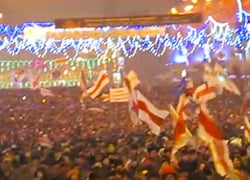 Ignoring Belarus’ problems led to the spreading of the dictatorship violence all over the post-soviet area.
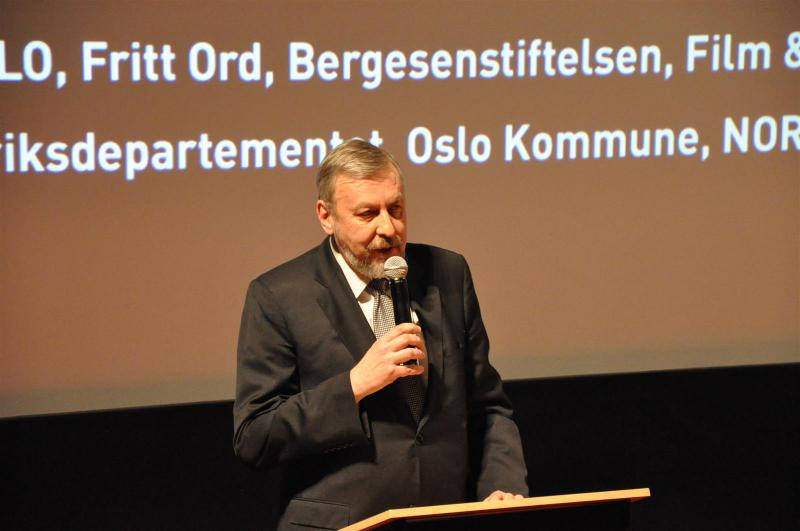
The leader of the European Belarus civic campaign, candidate for president in 2010 elections Andrei Sannikov and charter97.org web-site’s editor-in-chief Natalia Radzina visited Norway. In Oslo the former political prisoners met the State’s Secretary of the Ministry of Foreign Affairs of Norway Morten Glad-Pedersen and members of Norwegian parliament, were honorable guests at the documentary festival Human Rights Human Wrongs, which opened with Madeleine Sackler’s film ‘Dangerous acts starring the unstable elements of Belarus’, and gave interview to leading Norwegian media.
“It is very important to keep remembering Belarus. Norwegian people should support Belarusians, who are fighting for freedom today. We should demand that Lukashenka immediately released political prisoners, stopped the repressions and started observing human rights. The sanctions against his regime must be kept in place and even strengthened. Simultaneously the open door policy should be pursued toward the people of Belarus, civil society should be supported.
We should constantly remember that Belarus is a part of our European family. Now there is a dictatorship there. Europeans, including Norwegians, should be doing all possible in order for dictator Lukashenka to quit. While he rules, none positive changes are possible in Belarus”, - one of the organizers of the Belarusians’ visit, representative of Norwegian Helsinki Committee Berit Lindeman stated.
At the meeting with Norwegian MFA’s Secretary of State Andrei Sannikov and Natalia Radzina spoke of the situation around political prisoners, as well as the necessity for the West to develop a strategy towards Belarus, which is the region’s key country.
“The link cannot be missed between the protests in Belarus in 2010 and what is taking place in Ukraine. This is the confirmation of one simple thought: Europe cannot negotiate with dictators hoping to change for the better the situation in countries, where they rule. Very important processes are developing today in Ukraine, and it gives hope that Europeans behave differently there than in Belarus. There are constant contacts both with the authorities and opposition, civil society and oligarchs. Europe has finally started speaking substantially of significant financial support to Ukraine in the transition period. In this situation Belarus cannot be ignored. On the contrary, the people of Belarus, the civil society and opposition need greater attention and greater support, since the situation there is more complicated than in Ukraine.
The failure of the summit in Vilnius should not lead to slackening the attention toward Belarus as the whole region’s key country. Unfortunately today the support has gone weaker even on the most painful topic of political prisoners, who are in a terrible situation and should be released immediately. Norway, which is not an EU member, can make more decisive steps and put forward demands to stop the repressions”, - the leader of the European Belarus claimed.
“The latest events in the countries, where authoritarian and dictatorial regimes are in power, show the increased role of the internet, internet-media, social networks, civil journalism. This is one of the fields that should be supported. Also real rather than declarative support should be provided for the democratic movement and human rights organizations in Belarus. Many EU’s mechanisms are so bureaucratized that it is practically impossible to get support. Very often the support so necessary for democrats goes to pro-government institutions.
Sometimes it seems that they have forgotten about Belarus in Europe, put their hands down, having lost hope to change a thing. But the changes are possible in the country at any moment. Belarusians hate the dictator. It is the fear of repressions that yet holds them from openly protesting. There are 1460 policemen per 100 thousand citizens in the country, leave alone secret police. In order for changes to happen, we need international solidarity, western politicians’ adherence to the principles regarding Lukashenka and support to the democratic movement”, - Natalia Radzina said.
In the parliament of Norway the Belarusians met representatives of various parties. At the meeting many issues were brought up, including that the PACE’s Parliamentary Assemble could do more than it does today, in particular, to take into consideration the Moscow mechanism, which is not being used in due way toward our country. At the Parliamentary Assembly’s February session these issues will be discussed, and Norwegian MPs will be there.
Andrei Sannikov and Natalia Radzina were also invited to open the documentary festival Human Rights Human Wrongs that started these days in Oslo. The first film on the festival’s program was the documentary by Madeleine Sackler ‘Dangerous acts starring the unstable elements of Belarus’. The documentary tells the story of the Belarus Free Theater. However the main line is not only on the theater group, many of whom had to leave Belarus after the presidential elections 2010.
The film shows the tragedy of Belarus – a country in the middle of Europe, which is not sexy – there is no oil, gas, sea or mountains. There are only people there, but people are not an attractive merchandise, that is why no one pays attention to the dictatorship in the center of Europe today.
“There has never been particular attention to Belarus, where a dictator has been ruling for 20 years already, where people are kidnapped and murdered, where there are political prisoners in jails, where all the rights and freedoms are violated. Yes, they have called our country Europe’s last dictatorship and… forgotten about it.
We are very grateful that human rights activists and civic activists all around the world show solidarity with our country, we have many friends here in Norway. But European bureaucrats practically close their eyes on what is taking place in Belarus: instead of decisive actions resolutions were made with no consequences for the authorities in case the resolutions get ignored. Sanctions were put in place, but of rather symbolical meaning.
It resulted into the people of Belarus losing 20 years, while many Belarusian heroes, who fought for the freedom of Belarus, gave their lives. Moreover, the virus of Lukashenka’s dictatorship is spreading to the neighboring countries today. Problems with democracy in Ukraine and Russia are the result of the fact that the West has been closing its eyes on the dictatorship in Belarus.”
Despite a terrible dictatorship existing in the center of Europe in 21st century, courageous people live there, who fight for freedom and European values.
We have islands of freedom, including ones like the Free Theater, the documentary on which we will see, there is the charter97.org web-site, other projects. We are doing everything possible for Belarus to become free. Help us with that. Belarusian people very much need allies and friends around the world”, - Natalia Radzina said at the festival’s opening.
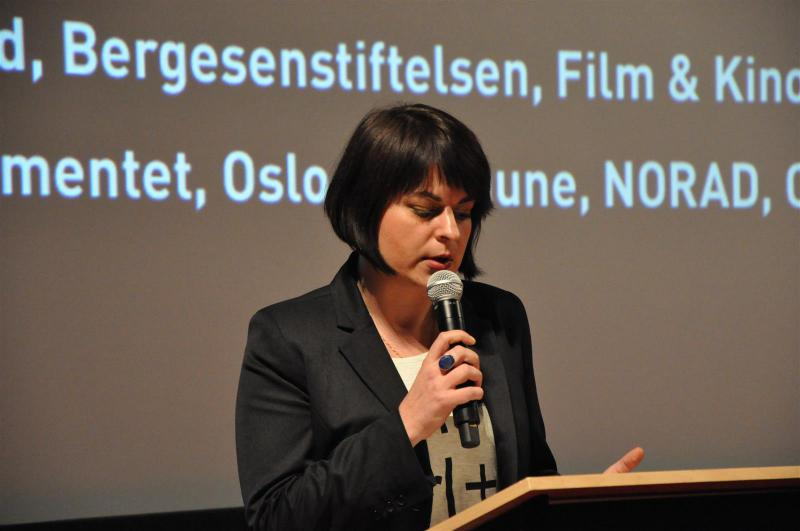
“This is a wonderful festival, but not a very joyful event, since the films will be shown here about the countries, where human rights are violated. I am proud of being asked to speak before the documentary on the Belarus Free Theater and its founders, my friends Mikalaj Khalezin and Natalia Kaliada. This is a very bright and energetic theater that raises acute issues in my country and the world. The film’s director started working on this project before the 2010 presidential elections. Then the 19 December happened, a peaceful manifestation that was brutally dispersed. I was a candidate for president and on that night I was beaten and arrested, ended up in prison just like my wife and friends. Kolia and Natasha managed to escape Belarus, running from persecution. Madeleine Sackler did not expect for her film’s plot to develop in such a way. Neither did we. Our manifestation was a moment of spiritual upheaval, a hope for changes, for freedom. This gave the dictator animalistic fear, and he brutally suppressed the peaceful protest.
Hundreds of people ended up in prisons, where we were only saved by the solidarity of the people of Belarus and international solidarity. You could not imagine what letters mean for a political prisoner. We received them in thousands, me too. Many of them did not reach, but those that did from world’s different countries very much supported us. Norwegians wrote to me as well. Belarus has many friends here.
What happened in December 2010 in Minsk is today happening in the Ukrainian Maidan, which also requires our solidarity and support. It will not take you long to write letters to political prisoners, to sign a petition, to express your attitude towards a dictatorship. Believe me, even the simplest actions help consolidating the solidarity with the people fighting dictatorship like it is the case in Belarus. Now I want to teach you two most important words in the Belarusian language. Apart from helping you to emotionally connect with the documentary, you should know that these words help us live, fight and to us they mean a free future. I want these words to sound in support of Belarusian political prisoners: Ales Bialiatski, Mikalaj Statkievich and others as a demand for their release. Be sure, they will know about it. These words are “Zhyvie Bielarus!” (Long live Belarus! – ed.).
The one and a half hours of the ‘Dangerous acts starring the unstable elements of Belarus’ documentary went in complete silence. People were astounded at the stories of the Free Theater’s actors, Andrei Sannikov, as well as the shooting of the Square’s dispersal on 19 December 2010, which led to about a thousand people being imprisoned.
As the audience’s numbness let go, the applause went on for long.
The showing of the documentary was attended by politicians, diplomats, civic activists as well as representatives of Norwegian Olympics Committee, who became more interested in the political situation in the region due to the Olympic Games in Sochi.
Many were really impressed that at the film’s end the words “Zhyvie Bielarus!” were said by and American actor Philip Seymour Hoffman, who has recently passed.
Kilde : http://charter97.org/en/news/2014/2/7/86081/
Abonner på:
Innlegg (Atom)