The
relations between Poland and Belarus are improving thanks to the
changes in the relations between the European Union and the Eastern
Partnership member states, Polish chargé d'affaires ad interim Michael Habros said at a press conference.
Michael Habros: “We can see a thaw in relations
now – Belarus sanctions have been frozen until the end of February,
there are changes for the better in the political dialogue. The same
applies to Poland: Poland’s position in the EU as regards ‘the eastern
policy’ is very important. It means that our relations with Belarus may
also be changed.”
Despite the warming of Belarus-Poland relations, there has been no
Polish Ambassador to Belarus for a few months already, Euroradio told
the diplomat. The delay can be explained by domestic political processes
in Poland, Habros replied.
Michael Habros: “There
is an internal political process observed in Poland now. We have just
gone through the parliamentary and presidential elections. The new
Ambassador’s candidature is still being disused. I think that the Polish
Ambassador will arrive in Minsk soon.”
However, Michael Habros refused to comment on the exact date.
The Euroradio reporter also asked the diplomat about the prospects of
the small border movement agreement. The document was signed and
ratified in Warsaw long ago, the Polish diplomat noted. It is up to
Belarus now. The official Minsk has not been able to make its decision
for several years. Photo: Zmitser Lukashuk Kilde: http://euroradio.fm/en/poland-belarus-relations-depend-belarus-eu-relations
On
Monday, December 28, the Thai Pattaya hosted the annual tournament of
the Top King World Series in the average weight category (70 kg). Based
on the yearly results Belarusian fighter Dzmitry Varats was selected to
fight at the tournament.
In the very first match our guy unexpectedly knocked out the well-known Tai professional Kem Sitsongpeenong.
But
the main test awaited Varats ahead. In the final, the Belarusian fought
with Hayal Zhaniev, who last season won the most popular fighter in the
world Buakaw Banchamek.
Dzmitry was able to stop the powerful pressure of the opponent and
lure him into his playing style of fighting. The judges gave the victory
to the Varats after the additional round.
Dzmitry
Varats is mostly living in Hrodna, but he trains with the famous
Belarusian expert Yuras Bulat in the Bulat Gym club. Interestingly, the
coach usually uses Belarusian in social networks.
Belarus will not follow Russia’s example and will not leave the free trade zone with Ukraine on January 1, 2016, UNIAN reports quoting Ukraine’s trade representative Nataliya Mikolskaya.
A Ukrainian delegation is discussing trade issues in Belarus now. The
removal of restrictions in mutual trade is being discussed at the
moment, the Belarusian MFA press service reports. Senior deputy Minister
for Foreign Affairs Alyaksandr Mihnevich is the head of the Belarusian work group and deputy Minister for Economic Development and Trade Nataliya Mikolskaya is the head of the Ukrainian work group. “All the sore points have been discussed at the meetings. The Republic of Belarus will not leave the FTZ with Ukraine,” the Ukrainian official wrote on Twitter.
The free trade zone exists in the Commonwealth of Independent States.
Russia is leaving from this zone with Ukraine on January 1, 2016. The
trade and economic part of the Association Agreement between the
European Union and Ukraine will come into force on this day.
Photo: rstk.by
A famous Belarusian artist Ales Pushkin has been to the
field of fighting in Ukraine and has painted his vision of the
situation.
However, these works, as it has turned out, are not so easy to show to the public now.
For the artist Ales Pushkin
the coming year will primarily become a test if the culture would
become free from censorship, if he would be allowed to open an
exhibition dedicated to the events in Donbas, Radio Racyja reports. “From
the 3rd to the 9th of November this year, I was part of an
international Belarusian-Ukrainian plein air in places of antiterrorist
combat operations. And I have come up with some works. The first work I
showed at the jubilee exhibition of the association “Pahonia”, which was
held in the Palace of Arts on November 24. Censorship has banned it. I
think that in 2016 we will try to demonstrate this exhibition on a full
scale in Belarus, and it is about 50 works.“ “The best
proof of Lukashenka’s slogans of the year 2016 as the year of culture
would be getting rid of censorship just in the sphere of culture,“ – Ales Pushkin said.
Ex-President of Georgia, and now – the head of the Odessa
region and one of the most prominent figures in Ukrainian politics gave
an exclusive interview to Belsat, where he spoke about the role of
Belarus in the war in Ukraine, Belarusian prospects in Europe and
Georgia’s gratitude to Lukashenka.
The conversation took place in Warsaw during a visit of Mikheil
Saakashvili to the conference dedicated to the memory of the deceased
Polish President Lech Kaczynski. Soon Belarus may get a Russian military air base. What is the role played by Lukashenka in Putin’s war in Ukraine?
I do not feel that Lukashenka is conducting an anti-Ukrainian policy.
As far as I know, he had a good relationship with Victor Yushchenko and
the “orange” government, but for some reasons, he had a bad
relationship with Viktor Yanukovych, they had a conflict. Lukashenka has
always been good at taking the Russian heat, especially at the first
stage of the war in Ukraine. It would be very dangerous if Belarus
joined the conflict.
I believe that Russia is stuck in Ukraine because Ukrainian
soldiers showed their heroic resistance, and I think one of the main
reasons why Russia went to Syria is a desire to divert attention from
Ukraine, where it did not have any progress.
In Syria, however, they also have no game. They will bomb the rebels,
but Assad is likely to be overthrown. To avoid this, they need to
introduce ground forces, then it will be a new Afghanistan. Aviation
will let them win the war, especially after the plane was shot down by
the Turks.
If oil prices remain at current levels, Putin will not be able to
play. And it is impossible to defeat Ukraine, Ukraine may only defeat
itself. Why did you congratulate Lukashenka after the 2010 elections, when protest rally in Minsk was brutally dispersed? For us the choice was very specific. Lukashenka was under great
pressure from the Kremlin. It was not just pressure and blackmail: he
was offered $2 billion for the very week Belarusian economy (in fact, it
is also weak now) to recognize South Ossetia and Abkhazia. And he did
not do it. I cannot forget it, it was very important for us, for such a
small country as Georgia. It was a signal not to Lukashenka, but to the
people. At the time, there were certain conventions, which I am not
rejecting now.
Saakashvili celebrated in Warsaw his 48th birthday.
I understand the problems related to the regime of Lukashenka, but
when it was important for Ukraine that during the war in the east
Belarus took a neutral position, Belarus did it.
Belarusians have tremendous potential to develop democracy, to live in
freedom and have a future — I am absolutely convinced of this. After
solving their problems, Belarus will move to Europe much faster than
each of the countries in our region — just on the basis of geography,
the nature of Belarusians and objective reality.
What reforms would you conduct in Belarus, if you could?
I have been living in Ukraine for a long time, and I identify myself
with this country. But for Belarus, I have only warm feelings, and I
cannot imagine myself in any role in the Belarusian government.
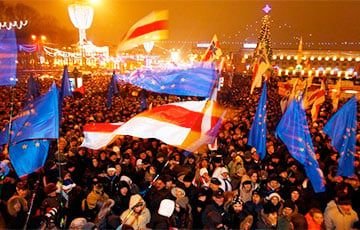
Five years ago tens of thousands of people gathered on the Square.
On December 19, 2010 a mass protest rally against the rigged results of the elections was held in Minsk. Charter97.org website asked people directly involved in the events and former political prisoners to tell what this day means to them. Andrei Sannikov, the leader of the European Belarus civil campaign, a presidential candidate in the elections – 2010:
“I
am very pleased that all the people who were defendants in the derisive
trials held after December 19, 2010 are finally released, in
particular, Mikalai Statkevich. It is probably the most joyful thing
which could be said on the 5th anniversary of the Square.
It is
obvious that it was a moment of a real people’s elation, which had been
caused by the political campaign of the year 2010. Unfortunately, that
proved to be impossible to repeat in Belarus up to this moment, and not
only because crackdown and apathy. Tragic events have taken place in the
neighbouring country – the war between Ukraine and Russia.
What
transpired and became visible then – resentment against the regime –
remains the same at the moment as well. The attitude of Belarusians to
Lukashenka has not changed. We came to the Square in order to change the
situation. This year people haven’t gone to the polls in a hope to
change the situation as well. The onward movement, which is to bring us
to changes, continues.
The same mobilization like in 2010 is
needed today. There are all conditions for that. it is obvious that the
life in Belarus is getting only worse, the economy is eroding, no
promises of the dictatorship, even minimal ones, are carried out. We
should take the history in our hands and change the life.
I can
say that I still feel gratitude to those who gathered on the Square
then, I know that Belarusians are ready to repeat that. We do not have
much time to save the country. It should be done right now.” Natallia Radzina, editor-in-chief of charter97.org:
“Western
journalists often ask me the same question: “If you had a chance to
return to the day of December 19. 2010, what would you do?” I always
answer that I would come to the Square, even knowing that beating, jail,
tortures and forced emigration were to follow. I would feel ashamed for
myself and for my nation, if it were not for this uprising against the
regime, terrorizing Belarus for the last two decades.
Ukrainians
are calling the Euromaidan the Revolution of Dignity. In 2010 we also
had the Uprising of Dignity. People who took to the streets then,
started to respect themselves, and made the world to respect the
Belarusian nation.
I am sure that the struggle of Belarusians
against the dictator is still to express itself in a mass street
protest, as in the conditions of tyranny changes could take place only
in this way.”
Dzmitry Drozd, a historian, a participant of the Square - 2010 and a former political prisoner:
“It
was one of the most significant events for me. Everything that has
happened in Belarus over the last five years, was a result of the
Square, which changed our life, out attitude to life itself. This event
is one of the most significant ones, not only in fates of its
participants, but in the modern history of Belarus.
For those who
had experienced that, and felt it in the lives of the loved ones,
nothing left its significance since the day of the Square in 2010.”
Zmitser Bandarenka, a coordinator of European Belarus civil campaign:
“In
2012, after my release from prison, I had a public discussion with a
bastard (I cannot call him by any other word) from Tell the Truth
campaign. He was shouting to me: “You, Sannikov’s team, and your Square
are a failure.” I answered to him that “for you, for the KGB and
Lukashenka, the Square is really frightening, and for us and for most
Belarusians, the Square is an event we can only be proud of.”
It’s
human nature that people like adventure films and action films. And it
happens so in the history of present-day Europe, that the historic
events, which allowed avoiding violence, or when one side deliberately
renounced the use of force, do not receive deserved recognition
sometimes. And only decades after, the understanding of the immensity of
these events comes.
Among these events could be names the
Belavezha Accords, which allowed avoiding the war between the nuclear
states, Russia and Ukraine, the round table in Poland, Maidan in Kyiv in
2004, the Square in Minsk in 2006 and 2010. Due to their fear and
weakness maniac dictators often resort to the use of force. People, who
are strong spiritually and are sure that they are right, try to find
common ground, in order to avoid death and violence. And today, 5 years
after the events of December 19, 2010, the force of thousands of
Belarusians, who rallied on the Square, wisdom of real opposition
leaders, like Sannikov, as well as historical pettiness of Lukashenka
and his collective farm’s gang, are evident.
Building of the new Belarusian nation is taking place exactly through the Square.”
 The
relations between Poland and Belarus are improving thanks to the
changes in the relations between the European Union and the Eastern
Partnership member states, Polish chargé d'affaires ad interim Michael Habros said at a press conference.
The
relations between Poland and Belarus are improving thanks to the
changes in the relations between the European Union and the Eastern
Partnership member states, Polish chargé d'affaires ad interim Michael Habros said at a press conference. Despite the warming of Belarus-Poland relations, there has been no
Polish Ambassador to Belarus for a few months already, Euroradio told
the diplomat. The delay can be explained by domestic political processes
in Poland, Habros replied.
Despite the warming of Belarus-Poland relations, there has been no
Polish Ambassador to Belarus for a few months already, Euroradio told
the diplomat. The delay can be explained by domestic political processes
in Poland, Habros replied.