Sider

mandag 28. mars 2016

Мэмарыяльны знак беларусам, якія загінулі за Ўкраіну, адкрыты ў Кіеве

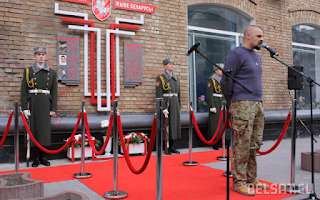
Monument to Belarusians who died for Ukraine opened in Kyiv

A cross with the inscriptions “Glory to Ukraine!” and “Long live Belarus!” is located in the street named after our country.


A monument to Mikhail Zhyzneuski, Ales Charkashyn, the Belarusians who gave their lives for Ukraine on Maidan and in the ATO zone, and Vitaly Tsilizhenka, a fighter of the tactical group ‘Belarus’, has been opened in Kyiv today. More than a hundred people have been present at the ceremony.
The white-red-white cross and a commemorative plaque are attached to the wall of the building at Belaruskaya Street, 22.

Read also: Minsk. Funds raised for Belarusian volunteer fighters in Ukraine

‘Belarusians with Ukraine in heart’ photo

Works of Belarusian artists have been on display in Kyiv. The pictures appeared on the Ukraine-Russia front.

Last September, 6 artists traveled to Donetsk and Dnipropetrovsk regions. They lived with the soldiers and volunteers, slept in barracks, ate in the dining rooms, dressed in military clothing and bulletproof vests.
On February 11, Ales Pushkin, Andrei Takindang, Hennadz Drazdou, Ales Susha, Ales Tsyrkunou with Ukrainian artist Taras Nosor presented the results of their creative trips at the Ukrainian Embassy in Minsk.
On March 27, similar exhibition entitled “Belarusians with Ukraine in the heart” opened at the National Museum of History of Ukraine.
You can see a report by Anton Tsyalezhnikau “Brushes Instead of Machines.” It is dedicated to the plein air that Belarusian artists held near Donetsk.


Мультфільм «Дзень Волі» / Freedom Day, Belsat TV animated film (ENG)


What is Freedom Day? Belsat TV has
made a short animated film on the occasion of Freedom Day (Dzień Voli),
which is a truly sacred holiday for each Belarusian patriot.

“Everyone has their own Freedom Day. One
day you say to yourself: “Stop! Enough of this humiliation, oppression,
all-timr telling what to do, what is allowed and what is forbidden. And
you break free, your chains fall, and you future life depends only on
you. But there is not only a personal Freedom Day. A common, national
Fredom Day also exists. It happens when free people in an unfree country
turn against the occupants’ oppression and take responsibility for
their homeland in their own hands. March 25 is Belarusian Freedom Day,
the day of our freedom and yours.”
Freedom Day is an
unofficial holiday in Belarus, which is celebrated on March 25 to
commemorate the creation on that date in 1918 of the Belarusian People’s
Republic (BNR). It came into existence at the end of the First World
War, when Bolshevik forces left Minsk and the city was occupied by
German troops. On March 25, 1918 the Provisional Government (Rada)
proclaimed the independence of the BNR. After the Red Army re-entered
Minsk, the Communist government replaced the Rada; its members had to
emigrate. The current regime denies Freedom Day and often prevents the
opposition forces from celebrating it.
Daroha, belsat.eu


Belarus increases fuel supplies to Ukraine


Belarus is increasing diesel oil and petrol supplies to Ukraine while the supplies from other countries are going down, oilnews.com.ua reports. The supplies of diesel oil from Belarus to Ukraine have increased by 70% and totalled about 208 thousand tons in February 2016. The supplies from the plants PKN Orlen have greatly increased – the import from Lithuania has gone up by 66% (28.3 thousand tons), the import from Poland (9.6 thousand tons) has decreased by 2.5 thousand tons. Nothing was imported from Russia in February.

The import of petrol has decreased by almost 19% in Ukraine – to 96.6 thousand tons. Lithuania has decreased its supplies by almost 41% and Poland – by 59%. Belarus has become the main exporter of petrol: the supplies have increased by almost a third – to 76 thousand tons.

Kilde:  http://euroradio.fm/en/belarus-increases-fuel-supplies-ukraine

Massive Celebration Of Freedom Day Takes Place In Minsk

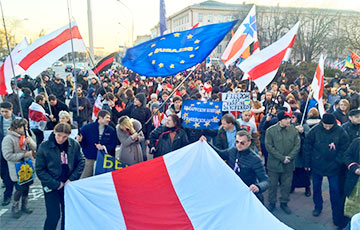
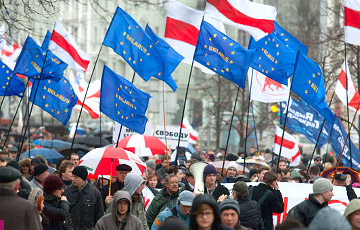
About 3,000 people took part in the march in the centre of the capital.
This year the rally on March 25 differed from the habitual format of Freedom Day celebration for at least three reasons: far more people have taken part in it than in recent years (about 3,000 participants); there were very many young people and “new faces” at the rally; the organisers and participants “broke the mould” or the plan, expected by the authorities, several times: first when they invited people to gather at 5 p.m. near Yanka Kupala monument, during the meeting near the Academy of Sciences, when they decided to walk to Riga supermarket in Surhanau Street, not to Bangalore Square, and in the end, when the young people refused to disband despite the call of the organisers, and continued celebration, and held a spontaneous meeting near Riga supermarket.
The celebration was held in a festive mood, many people were with their children and families, many songs were sung: hit songs by Liapis and Brutto, songs of NRM and Volski.
The rally started at 5 p.m. in Yanka Kupala Park: in response to the appeal of Mikalai Statkevich and other opposition leader more than a thousand of people came there to lay flowers to the monument of the national genius.
Other leaders of opposition, who came to the monument, were Anatol Liabedzka, Paval Seviarynets, Viachaslau Siuchyk, Uladzimir Niakliayeu, a European Belarus coordinator Maxim Viniarski, young activists Paval Vinahradau, Viachaslau Kasinerau, Paval Yukhnevich, leaders of sole traders Ales Makaeu and Mikalai Charnavus, a filmmaker Volha Mikalaichyk, parents of the Heavenly Hundred’s hero Mikhail Zhyzneuski. Many people had brought flowers, white-red-white flags were unfurled. One of the participants was with a Ukrainian flag, in order to support Nadiya Savchenko.


Participants of the rally were holding posters: “Freedom Day,” “BNR Emerged Without Authorization Of Minsk City Executive Committee,” “Your House Is On The End Of Village [It’s No Concern Of Mine], You Say? House At Village’s End To Burn First,” “Freedom To Nations – Death To Empires.”
People were chanting: “Long live Belarus!,” “We Believe, We Can, We Shall Win!”, “Independence!”
Mikalai Statkevich, Anatol Liabedzka, Paval Seviarynets, Viachaslau Siuchyk, Uladzimir Niakliayeu addressed the people who had gathered near Kupala monument. Stakevich offered to lay flowers and announced that there would be a march along Independence Avenue to the Academy of Sciences, and later people would decide themselves, whether they are going to follow the route to Bangalore Square, offered by the authorities. A poet and politician Niakliayeu read a poem dedicated to Yanka Kupala and Yakub Kolas. Viachaslau Siuchyk offered to hold a moment of silence to honour those who had laid down their lives for independence of Belarus. Anatol Liabedzka compared the current regime with ” sewage pipe, drifting all kind of decrees and problems”.
After the meeting and laying the flowers Statkevich urged people to form a column and move towards October cinema near the Academy of Sciences.

On the avenue the column occupied all the space from the circus up to the bridge over the River Svislach. People were in a celebratory mood. They marched along the avenue chanting “Long live Belarus!”, “Give Us Land, Freedom!,” “Independence!”, We Believe, We Can, We Shall Win!” Anarchists lit a flare on the bridge. The passing cars welcomed the demonstration with honks, Minsk dwellers were waving hands from windows, came out of cafes, some of them joined chanting “Long live Belarus!” A huge white-red-white flag was unfurled in the head of the column.
Policemen and traffic policemen were almost invisible, people in mufti were filming the rally. During the march several persons in mufti tried to hide the streamer “Your House Is On The End Of Village [It’s No Concern Of Mine], You Say? House At Village’s End To Burn First” with their bodies.
New people were joining the column during its movement, and more than 2,000 people came up the Academy of Sciences. Organisers held a short meeting near Yakub Kolas monument, people laid flowers to the Belarusian poet.
At about 6 p.m. the column of protesters blended into the crowd of those who had come to October cinema near the Academy of Sciences from the start. An address of the chairperson of the Rada of the Belarusian People’s Republic Ivonka Survilla to the Belarusian nation was read out. It said about “seeing each other in a free Belarus before long.”

The chairman of the Belarusian Popular Front party Aliaksei Yanukevich, Anatol Liabedzka, the leader of sole traders Ales Makaeu addressed the meeting. Liabedzka said that “the source of all country’s problems is in Drazdy cottage estate” [where the president and top officials live], and demanded “to bring Drazdy dwellers, Drazduny, to account.” The deputy chairman of the UCP Mikalai Drazdou brought the same poster to the Academy of Sciences.
At the meeting Makaeu announced launching of two campaigns – for collecting 50,000 signatures of sole traders for forwarding to the Constitutional Court a demand to reverse the Decree №222 and for recognition of Mikhail Zhamchuzhny and other human rights activists as political prisoners.
The speech of Viachaslau Siuchyk was a surprise. He offered not to do the bidding of the government and not to march to Bangalore Square, but to march up to Riga supermarket in Surhanau Street. The name of the shop itself symbolizes the European choice of Belarus.
The offer was met by the audience enthusiastically, and people started to line up for the demonstration. Activists of Art Siadziba performed Warriors Of Light for the protesters, and it was a keynote for the procession’s mood.

As they marched to Riga shop, young people who were the majority in the column, sang Warriors Of Light, Hraj by Liapis Trubetskoy, Three Tortoises by Liavon Volski. It was a real holiday. Demonstrators chanted: “Sasha, It’s Enough – People Need Freedom!”, “Where Are wages?”, “Long Live Belarus!”, “Together Forever!” and “Glory To Ukraine.”
At 7.30 p.m. the procession came near Riga supermarket. Despite the proposal of Siuchyk to finish the rally, young people didn’t want to disband, and continued a spontaneous celebration of Freedom Day: they held performances, lit flares, sang Volski’s hit songs to a guitar accompaniment. The celebratory demonstration finished much later than the organisers and journalists had expected.

Mer bilder og video   http://charter97.org/en/news/2016/3/25/196661/

Belarusians Celebrate Freedom Day


98 years ago independence of the Belarusian People's Republic was proclaimed.
It happened on March 25, 1918. The Rada adopted the Third Charter that declared the full independence of the country. It was the first time when our people got a chance to create their own state.
Today Minsk hosts a mass event devoted to the anniversary of declaration of independence. Mingorispolkom has authorized the meeting on Freedom Day at 6 pm next to Oktyabr cinema (Akademia Nauk metro station). Mikalai Statkevich and a number of other opposition leaders urged participants to gather together at 5 pm near Kupala monument.
Young Belarusians - Yazep Voronko, Kastus Ezavitov, Ivan Serada, - the generation brought up on ideas of the national resurgence that began in Belarus in early XXth century, stood at the origins of the BPR. They all hoped for freedom after the World War I and February Revolution in Russia.
A possibility to implement it became possible after failure to negotiate with bolsheviks and Germany in early 1918 in Brest. Then the Soviet authorities who tried to impede the activity of Belarusian patriots were forced to leave Minsk and other large cities of the country and flee to Smolensk.
On February 21 the Executive Committee of the Rada of the All-Belarusian Meeting announced itself an interim authority in the country. Soon it was decided to convene an organizational meeting, which could be the first attempt to decide upon further fate based on democracy. Earlier, the interim authority - People's Secretariat with Yazep Voronko as the head - had functions of a new authority.
A few weeks later Belarus was announced a People's Republic. The government was transformed into the Rada of BPR headed by Ivan Sereda.
On March 25 Rada proclaimed a complete independence of the BPR. Pahonia coat of arms and white-red-white flag became symbols of a new state.
The BPR's government made every possible effort to establish national institutions. It was decided to grant a national status to Belarusian language, establish Belarusian schools and gymnasiums, cultural and educational societies and theaters, as well as publishing houses. Newspapers were published in Belarusian, and it was planned to open the National University in Minsk.

A number of European countries recognized independence of our country.
The Rada of BPR was supported by Belarusian councils in Mahilyeu, Hrodna, Vaukavysk, Slutsk and other towns. They immediately broke in activity building of new authorities at places.
Germany and the Soviet Russia did not recognize BPR, as well as they did not recognize the right to self-determination of other peoples which lived in their territory. Nevertheless, bolsheviks considered it a real state. They wrote "it is needed to devolve power of the BPR on the government of BSSR."
In virtue of a complex military and political situation Rada of the BPR could not fulfill the idea of the state sovereignty. The attempt to create an army and oppose bolsheviks in the east and Poles in the west failed. But the Soviet authorities recognized the popularity of the statehood among Belarusians. Therefore, on January 1, 1919 the Soviet Socialist Republic of Belarus was proclaimed in Smolensk within almost the same borders specified by the BPR. Soon units of the Red Army occupied Minsk and the government of the Soviet Belarus moved there. The Rada BPR had to emigrate.

Proclamation of the BPR had other implications besides forced proclamation of the SSRB by bolsheviks. Local Belarusian authorities created structures who managed to fight against communists during a decade. It often loomed to the Soviet power - for instance, the Slutsk uprising and support of Bulak-Balachowicz by Belarusian in Polesie. And above all, for the first time in decades it became an example of a success of the Belarusians. A year before events of March 25, 1918 only few people could imagine that Belarusians could have their own government and state even for a short time.


Kilde:  http://charter97.org/en/news/2016/3/25/196557/