Sider

torsdag 28. november 2013

International tribunal is needed today on the situation in Belarus

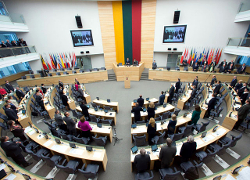
“International tribunal is needed today on the situation in Belarus”Special hearings on Belarus took place in Lithuanian parliament today.
They were timed to the Eastern Partnership summit, which would start in Vilnius, and had the aim of developing recommendations for the European Union and its policy towards Minsk.

The hearings were chaired by the deputy chairman of the Committee on International Relations of Lithuanian parliament Audronis Azhubalis and a parliament member Mantas Adomenas. In the hearings took part the head of the parliament’s Committee on International Relations Benediktas Juodka, leader of the parliamentary opposition and former Prime Minister of Lithuania Andrius Kubilus, relatives of Belarusian political prisoners Natalia Pinchuk, Maryna Lobava, Maryna Adamovich, the mother of the kidnapped journalist Dzmitry Zavadski Volha Zavadskaja, the chairwoman of the Belarusian Association of Journalists Zhana Licvina, the council member of the human rights center Tacciana Raviaka, charter97.org web-site’s editor in chief Natalia Radzina, the director of the Belarusian Human Rights House in Vilnius Hanna Hierasimava, representatives of the political opposition – co-chairmen of the organizational committee for creation of the party Belarusian Christian Democracy Paviel Sieviaryniec and Vital Rymasheuski, the leader of the Just World party Siarhiej Kaliakin, the leaders of Tell the Truth civic campaign Uladzimir Niakliajeu and Andrej Dzmitryjeu, deputy chairman of the Movement for Freedom Aliaksandr Lahviniec, a lawyer of the executive panel of the NGO Assembly Jury Chavusau and the coordinator of Eastern Partnership’s Civil Society forum from Belarus Andrej Jahorau.

The event was also attended by Lithuanian parliament members, the parliament’s ombudsman, representatives of foreign embassies and foundations.
As he was opening the hearings the Lithuanian parliament member Mantas Adomenas stated that human rights should not be forgotten with all the attention going to transit and exports. According to him, Lithuania should be the Europe’s mouthpiece for the Belarusians aiming towards freedom. “What is happening in Belarus reminds of the Soviet Union times”, - he said and emphasized that it is nowadays impossible to imagine that in Lithuania “journalists would be forbidden to tell what they want”. “This is the difference between Lithuania and Belarus. I can hardly imagine for political prisoners to be there in Lithuania”, - Mantas Adomenas claimed.

The leader of the parliament’s opposition Andrius Kubilus noted that the hearings were the indication that the situation in Belarus had not been forgotten. He claimed that sometimes one should actually force themselves to understand that “what is taking place in Belarus, and what people experience in their daily lives, are not just violations of human rights and democracy. There are human tragedies behind these words”. “It is impossible to put up with the current situation in Belarus, but our joint effort is required for that”, - he concluded.

Former political prisoners and relatives of the repressed spoke first at the hearings.
Paviel Sieviaryniec thanked Europe for the principled position on political prisoners. “If it was not for your adherence to the principles I would probably not have been here with you now, because it is only Europe’s firm stance that restrains the incumbent regime from more brutal repressions. Once such a principled position of Europe led to the world’s recognition of the fact of Soviet occupation of Lithuania, Latvia and Estonia”, - he claimed. Paviel Sieviaryniec emphasized that Belarusian political prisoners were hostages in the literal meaning of the word. “The regime keeps holding a critically important number of people, keeps bargaining. At the Belarus’ MFA they do not even hide the fact that there are political prisoners. The EU should proceed with sticking to its principles and insist on their release and exoneration”, - the politician said. He highlighted that another leverage over Lukashenka would be the Ice Hockey World Championship, which is scheduled to take place next year in Minsk.

Then spoke political prisoner Ales Bialiatski’s wife Natalia Pinchuk. She told about the situation, in which her husband is now. According to her, the conditions of his imprisonment have worsened. In the course of last year he did not have any long-term meeting and received only one parcel.
The mother of the disappeared journalist Dzmitry Zavadski Volha Zavadskaja reminded that nothing changed on the case of the kidnapped Belarusians in the past 12 years. “All the terms expire, and we are afraid that the topic of violent disappearances may vanish. It is very important for these crimes, which are crimes against humanity, were not forgotten”, - she claimed.
The wife of political prisoner, former presidential candidate Mikalaj Statkievich Maryna Adamovich shared in detail the latest news on his situation. The conditions have worsened. Maryna Adamovich emphasized that exoneration of political prisoners should remind on the agenda regardless of whether Belarus’ authorities do that or not.

The mother of political prisoner, Young Front’s co-chairman Eduard Lobau Maryna Lobava spoke at the hearings. She claimed that the conditions of her son’s imprisonment might be equated to tortures. “Only economic sanctions, introduced immediately after the events of 2010, helped release many political prisoners. Only owing to targeted economic sanctions, which took place, we now have 10 political prisoners instead of 50. Like before. The release of political prisoners and holding of free and fair elections should be demanded of the Lukashenka regime. After the fulfillment of these demands, one may speak of any dialogue or any cooperation”, - Maryna Lobava emphasized.
The chairwoman of the Belarusian Association of Journalists Zhana Licvina told about the situation with the freedom of speech in Belarus, having noted that the control became total over media. She listed the latest dangerous trends: practice of the use of the extremism law against a publishing house, emergence of such formulations as “activities against the interests of the Republic of Belarus”. She also expressed a concern of authorities’ intention to introduce the obligatory registration for most popular internet information sources.

A human rights activist Tacciana Raviaka told about the situation with Ales Bialiatski and listed the names of all the political prisoners in Belarus, having reminded that another criminal proceeding would start the next day on the case of a youth activist Vasil Parfiankou. This shows, according to her, how vulnerable political prisoners are after being released. “If activists engage in politics, they are immediately subjected to repressions”, -she said. The human rights activists observed that Belarus ignored its obligations in the framework of international organizations: none of the UN’s Human Rights Committee decisions were followed.

Political scientist Jury Chavusau told about the violations of the freedom of association in Belarus. He noted that a number of organizations have not been able to get registered for 10 years. Many are pushed out of the country to go abroad, criminal responsibility keeps existing for acting on behalf of non-registered organizations.

Eastern Partnership Civil Society Forum’s coordinator for Belarus Andrej Jahorau pointed out the problem of EU’s assistance to democratic organizations. He claimed that sometimes programs are implemented with the support of the European Union, which are used by the authorities for persecuting civil society activists.

A co-chairman of the organizational committee for the creation of the party Belarusian Christian Democracy Vital Rymasheuski quoted independent Lithuania’s first chairman of the parliament Vitautas Landsbergis, who said that the export of corruption takes place from East to West, when Western countries start treating dictatorships with pragmatism. The Belarusian politician noted that such an attitude, realpolitik, is being used by Europe in its relations with the Belarusian regime. That is why, according to him, it is time to raise the issue of protecting the democratic values in the EU countries.

The head of the United Civic Party Anatol Liabiedzka reminded that a business forum was taking place in Vilnius that day. “This is where we should have spoken. Probably, Lithuanian businessmen would have had their eyes opened. It would also be useful for them to listen to Vladislav Baumgertner – a businessmen close to the Kremlin, who spent several months in detention in Belarus”, - he said. The politician emphasized that MFA’s head Makej, who would take part in the Eastern Partnership summit, was not a minister at all, but a simple “mailman”, who executes the orders from the dictator.
Uladzimir Niakliaeu stated that Makej was not only a mailman, but an accomplice to the Lukashenka regime’s crimes. According to him, Belarus needed its own Magnitsky list, because the people, who violate human rights, feel their impunity. Uladzimir Niakliaeu noted that visa restrictions alone were not enough for the officials, who carried out repressions.

Movement for Freedom’s deputy chairman Aliaksandr Lahviniec pointed out that Belarus first and foremost needed a European perspective. According to him, this is the only guarantee of a good standard of living in our country.
The leader of the Just World party Siarhiej Kaliakin made a specific suggestion. According to him, there currently were not 10-12 political prisoners in Belarus.

“Those are all the country’s residents. Tens of thousands of people are in prisons, and each one of them is tortured. Gigantic number of people undergoes repressions. The creation of an international tribunal should be initiated on the situation in Belarus”, - he claimed.

Kilde/Source :  http://charter97.org/en/news/2013/11/28/80711/

mandag 25. november 2013

27 november Heroes' Day

Краўцэвіч, Латышонак і Міхнавец заклікалі да агульнанацыянальнай акцыі ў Дзень Герояў

Heros Day i Hviterussland- en dag da det oppstod det væpnet opprøret i Slutsk i den nydannet Hviterussiske folkerepublikken i 1920 mot bolsjevikene.
  Hviterussere!
De kjempet for sin frihet og fedrelandet! De ventet ikke på hjelp fra noen! De ville selv avgjøre egen skjebne! De ga sine liv for Belarus, for oss, for deg!
Nittitre år siden. 27. november 1920, begynte Slutsk opprør. Våre forfedre kom for å kjempe for sitt land - Hviterussiske folkerepublikken.
I kampen side ved side kjempet den Slutsky Grozovskii stick, Slutsk First Brigade Væpnede menn BNR. De fikk også med seg den hviterussiske delen av hæren til general Stanislav Bulak – Balakhovich og geriljagrupper "Grønn Eik ".
Flere tusen opprørere frastøtt i en måned den bolsjevikiske invasjonen. De Siste troppene forlot slagmarken bare i januar 1921. Geriljagrupper har kjempet i noen år etter på.
Vår republikk ble født i blodig dødskamp, men vår hviterussisk indre ånd var gjenopplivet og vil aldri dø. Flere modige menn fra neste generasjoner kom for å kjempe for Belarus.
27 november vil alltid være Heroes' Day .
Derfor oppfordrer vi alle som bærer navnet hviterusser til å feire denne dagen og huske våre helter. Sett et stearinlys i vinduet for å minnes de og vise at vi husker dem.
Lenge leve Belarus!

Беларусы!
Яны змагаліся за свабоду сваю і Айчыны! Яны не чакалі ні ад каго дапамогі! Яны самыя вырашалі свой лёс! Яны паклалі свае жыцці за Беларусь, за нас, за цябе!
Дзевяноста тры гады таму, 27 лістапада 1920 года, распачаўся Слуцкі Збройны Чын. Нашы продкі выступілі на змаганне за сваю дзяржаву — Беларускую Народную Рэспубліку.
У бой рушылі Слуцкі і Грозаўскі палкі Першай Слуцкай Брыгады Стралкоў БНР. Да іх далучыліся беларускія часткі арміі Генерала Станіслава Булак-Балаховіча, якія раней біліся пад Мазыром — Беластоцкі батальён і Смаленскі полк, а таксама партызанскія атрады «Зялёнага Дуба».
Некалькі тысяч паўстанцаў на працягу месяца давалі адпор бальшавіцкай навале. Апошнія атрады сышлі з поля бітвы толькі ў студзені 1921 года. Партызанскія атрады прадаўжалі змаганне яшчэ некалькі гадоў.
Свая Рэспубліка нараджалася ў крывавых муках, але наш беларускі родны дух, які тады ажыў, не згасаў. На поле бітвы ў след за случакамі выходзілі наступныя пакаленні змагароў за Беларусь. 27 лістапада — іхны дзень: Дзень Герояў.
Таму заклікаем усіх, хто носіць імя беларуса, годна святкаваць гэты Дзень, успамінаць нашых Герояў і штогод ставіць у акне свечку. Няхай яе агенчык сігналіць Змагарам, што ў гэтай хаце помняць іх Чын.
Жыве Беларусь!

Алесь Краўцэвіч, Беларускае Гістарычнае Таварыства
Алег Латышонак, Беларускае Гістарычнае Таварыства ў Польшчы
Анатоль Міхнавец, Беларуская Нацыянальная Памяць


Чытаць цалкам http://nn.by/?c=ar&i=118349

lørdag 2. november 2013

Dziady


I Hviterussland har vi en tradisjon Dzjady når vi går i kirke og på kirkegården og ber for de døde. På den dagen lages det en rituell måltid som kan bestå av kutia (spesiell laget grøt), pannekaker, kjøtt, egg og annet. Det må være 7 forskjellige retter. På middagsbordet settes det en ekstra tallerken til de døde og på tallerkenen leger man en bitt av hver rett.  Tallerkenen skal stå på bordet over hele natten. Ifølge troen kommer de døde om natta til å sitte rund bordet i nattas stillhet.
 Denne tradisjonen i sin mest arkaiske formen bevart bare av hviterussere .

tirsdag 29. oktober 2013

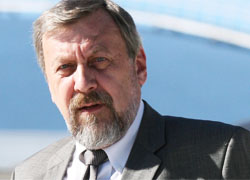
Andrei Sannikov: I'll continue to call for sanctions because they work

Andrei Sannikov: I'll continue to call for sanctions because they workA hardline policy towards the dictator and visa-free travels to the EU for ordinary Belarusians are needed.
Former Belarusian presidential candidate Andrei Sannikov said during an international conference in Vilnius on Tuesday that he would call for sanctions against the Belarusian government because "believe me, they work." 

"Lukashenka understands only the language of sanctions," Mr. Sannikov, a former political prisoner who was granted political asylum in Britain in 2012, said during the conference, which focuses on possible strategies for the EU's engagement with Belarus. "It is necessary to take a tough line on the dictator and his regime while involving the Belarusian public in a dialogue." 

Mr. Sannikov called on the European Union to abolish the visa requirement for Belarusians. This measure would do much more to increase pro-European sentiments in Belarus than any statements, he said. 


According to Mr. Sannikov, Europe failed to use its "window of opportunity" following the 2010 presidential election in Minsk. "The opposition was winning the election and I was the leading candidate," he said. "It's unclear why Europe didn't ask tough questions about the legitimacy of Lukashenka." 


Mr. Sannikov warned against "playing liberalization" with Belarusian authorities. "The situation in Belarus deteriorates after each such attempt," he said. "If Europe is ready to assume responsibility, indeed, personal responsibility, for further repression and murders in Belarus, let it continue its policy of engaging the regime in a dialogue." 


Yury Hubarevich, deputy chairman of the Movement for Freedom, said that in recent years, Mr. Lukashenka had been balancing between the EU and Russia, using a "pendulum policy" to good effect. "However, he is running out of room for maneuver," he said. "The Eurasian Economic Union Agreement may be signed in two years, which would be the point of no return for us." 
Mr. Hubarevich said that Europe's policy of rewarding "positive steps" by Belarus with preferences was not working. "Lukashenka's policy regarding the EU and Russia is very simple—get as much money as possible without making any decisions that may affect the stability of his government," he said. 

Mr. Hubarevich said that Europe should try to influence Mr. Lukashenka through the Belarusian public. "Lukashenka is forced to take public opinion into account," he said. "On several occasions, he backed down in the face of public indignation." For example, he had to order the reduction of motor fuel prices after their drastic increase and then withdrew his own proposal to impose a $100 exit duty on Belarusians traveling abroad for shopping, he said. 

Polls indicate that about 40 percent of the Belarusians are in favor of rapprochement with Europe, Mr. Hubarevich said, adding that Europe should use this lever to influence the regime. 

Anatol Lyabedzka, chairman of the United Civic Party, said that the EU should push for the release and exoneration of all political prisoners in Belarus and also demand that the government hold free and fair elections. If the government releases the political prisoners without exonerating them, the root cause of politically motivated persecution will remain, and new political prisoners will eventually appear, Mr. Lyabedzka said.

Kilde :  http://charter97.org/en/news/2013/10/29/78690/

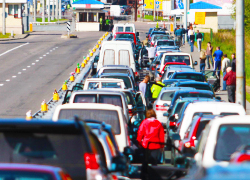
Belarusians must prepare for car tax


Belarusians must prepare for car taxA car tax will include taxes on ecology, parking lots and space.
Experts proposed to impose a car tax in Belarus in the article “Take Post”.
“People should understand that a car is a hazardous instrument both for space and ecology. People must pay for it,” Armen Sardarov, the dean of the Architectural Faculty of Belarusian National Technical University, said during a discussion of parking lots with Savetskaya Belorussia newspaper. “I think a car tax must include taxes on ecology, parking lots and the public space occupied by a vehicle.”
“It is a matter of health for every resident. Those who have met the situation when car owners warm up their cars every morning in the yard understand it. You cannot breathe there. But you cannot explain anything to car owners. They know just one thing: they park their cars here, so they will warm them up here, not in another place,” Armen Sardarov explained his proposal to impose an additional tax.
We remind that the municipal authorities put forward an initiative of imposing a car tax in 2009.
“We need a car tax in Minsk,” then chairman of the Minsk city executive committee Mikalai Ladutska said. “There are about 500,000 cars in the city. Car owners spend an average of 200,000 rubles a month on fuel, or 1 or 2 million a year. Let's collect at least 60,000-70,000 rubles from every car owner and we'll get 30 or 40 million annually.”
Mikalai Ladutska proposed yesterday to encourage Minsk residents to pay for parking lots construction.

Kilde :  http://charter97.org/en/news/2013/10/29/78664/

torsdag 24. oktober 2013

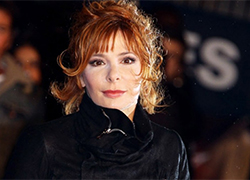
Mylène Farmer signs petition against the death penalty in Belarus


Mylène Farmer signs petition against the death penalty in BelarusThree days before her arrival in Minsk Mylène Farmer signed a petition of the campaign "Human Rights Defenders against the Death Penalty in Belarus."
The well-known French singer did not remain indifferent to a letter from the International Federation for Human Rights (FIDH) and the Human Rights Center "Viasna", in which human rights activists told her about the nature of the problem of the death penalty in Belarus - the last country in Europe, where people are still deprived of life on behalf of the state.
"There can be no higher goal, more holy, more worthy than this one: abolish the death penalty," Mylène Farmer quoted these lines when signing the petition. They belong to the French writer Victor Hugo, who in the preface to the novel "The Last Day of a Condemned Man" (1829) expresses his feelings that the death penalty should be abolished, wondering why one person has the right to take the life of another and claiming that his role is "the role of patron for all possible defendants, either guilty or innocent, before all the courts and the tribunals, before all the jurors, before all the arbiters of justice."
The petition calls on the Belarusian authorities to abolish the death penalty in the country: "Today, when all the countries of Europe and the former Soviet Union have abolished the death penalty, it is time for Belarus to join the civilized space of humanism, a space free from murder by the state."
Activists of the campaign "Human Rights Defenders against the Death Penalty in Belarus", launched in 2009, suggest signing the petition to the world-famous individuals – to emphasize the importance of the problem and to attract the attention of people all over the world to the death penalty as a problem that knows no national boundaries. In 2010, the petition was signed by the famous British musician Sting, who also recorded a video message entitled "Time to Change", and in 2012 the campaign was supported by the Swedish singer Loreen, the winner of "Eurovision-2012".

Kilde :  http://charter97.org/en/news/2013/10/24/78339/

lørdag 12. oktober 2013

Diktaturer bør ikke belønnes

En av de største skamplettene den avtroppende regjeringen etterlater seg, er en nesten ferdigforhandlet frihandelsavtale med Hviterussland, Europas siste diktatur.

Den nye regjeringen må få stanset dette prosjektet i siste liten.
Nylig startet den siste forhandlingsrunden mellom EFTA-landene Island, Liechtenstein, Sveits og Norge og tollunionen mellom Russland, Kasakhstan og Hviterussland om å inngå en avtale om frihandel. Forhandlingene gjennom hele året har gått såpass bra at Norge antagelig vil kunne inngå en frihandelsavtale med Hviterussland allerede i 2014. Norge står i spissen for forhandlingene. Grunn nok til å være fornøyd, vil sikkert noen mene. Flinke norske forhandlere, liksom.
Hadde det bare ikke vært for at det skjer omfattende menneskerettighetsbrudd i Hviterussland: storstilt overvåking av befolkningen, vilkårlig fengsling og tortur. Den politiske opposisjonen og sivilsamfunnet er under massivt press, og mediene kontrolleres i stor grad av staten. "I Hviterussland blir sivilsamfunnet kneblet av et undertrykkende regime som ikke tolererer noen form for kritikk", konkluderte Amnesty International i en rapport tidligere i år. Men hverken dokumenterte overgrep eller gjentatte runder med kritikk fra blant annet Venstre som stilte spørsmål om saken på Stortinget, ser ut til å ha gjort inntrykk på statsminister Jens Stoltenberg og nærings- og handelsminister Trond Giske.

Å inngå en frihandelsavtale med Hviterussland betyr å gi direkte støtte til Lukasjenkos brutale og illegitime regime. Mer enn 80 prosent av den økonomiske aktiviteten i Hviterussland eies og styres av staten. Avtalen vil også svekke de sivile og opposisjonelle kreftene i landet som arbeider for å fremme demokrati. Av nettopp denne grunnen har EU avvist å diskutere en slik avtale og dessuten innført en rekke økonomiske sanksjoner mot Hviterussland. Sanksjoner som Norge i 2012 sluttet seg til, forresten. Og så skal vi gå og undergrave dette ved å drive frihandel med landet i stedet? Hvordan kunne Norge synke så dypt i et så prinsipielt spørsmål?

De rødgrønne er blitt drevet av ønsket om økt handel med Russland. At menneskerettighetssituasjonen også i Russland er blitt forverret de siste årene, har jo aldri vært noe problem for regjeringen Stoltenberg. Forholdet til den store naboen i øst har vært ansett som svært viktig, ikke minst for norske olje- og gassinteresser. En frihandelsavtale skulle krone det strategiske partnerskapet, selv om Hviterussland følger med som nissen på lasset. Hensyn til menneskerettigheter, demokrati og politisk anstand måtte vike til fordel for økonomisk gevinst.
Regjeringsskiftet gir oss nå anledning til å stanse de videre forhandlingene umiddelbart – selv om disse befinner seg i den siste runden. Et nei til frihandel med Hviterussland vil sende et kraftig signal om at Norge etter Stoltenberg-regjeringen ikke ønsker å belønne avskyelige regimer gjennom handelsavtaler og at profitten ikke alltid slår knockout på etikken.


Kilde :  http://www.aftenposten.no/meninger/debatt/Diktaturer-bor-ikke-belonnes-7337154.html
Foto : http://www.arche.by/by/page/print/2960
          http://www.svaboda.org/content/transcript/24703300.html