The Belarusian politician believes that the stand of
the European Union on human rights situation in Belarus has become more
principled, than pragmatic now.
It was said by the former political prisoner, a co-chairman of the
organizing committee for creation of the Belarusian Christian Democratic
Party Paval Sevyarynets in an interview to charter97.org. -
You have taken part in the meeting of Belarusian opposition’s
representatives with the delegation of the European Parliament. What are
your impressions from communication with the European politicians?
-
The general impression from the meeting is the following: on the one
hand, Europeans want to use the geopolitical situation related to
Ukraine, and detach Belarus and Lukashenka’s regime from Russia. But on
the other hand, they understand that the regime does not want to agree
to any changes, but prefers to follow the Azerbaijani scenario. For
today I have seen that the stand of Europeans is rather principled, than
pragmatic. At least, among the politicians who represent the European
Parliament, there is realization that in case Lukashenka wouldn’t
release political prisoners, any serious easing of some requirements,
and especially recognition of the election, are out of the question.
There are two things that are worrying the politicians from the
delegation of the European Parliament most: release of political
prisoners and the situation with the so-called “election.” These people
do not have illusions, most of them are politicians, who have been
working with Belarusian agenda for a long time. - And what statements have been specifically made by the delegation on the problem of political prisoners in Belarus?
-
At least, Bogdan Zdrojewski, who is the head of the Delegation for
relations with Belarus in the European Parliament, stated that the
position of Europe on political prisoners in Belarus is a fundamental
point. And without their release Lukashenka’s regime cannot count on
serious improvement of relations with the European Union. Besides, the
European politicians have stressed that they hadn’t recognized and would
not recognize the lower chamber of the Belarusian parliament, the
so-called “little chamber, or tent” without holding free election. -
In the run up to the visit the intention of the delegation of the
European Parliament to meet with relatives of the political prisoners
was announced. Have these meetings taken place?
- It’s true,
it was on the programme of the visit. Probably, our meeting, the meeting
of opposition representatives, had been held earlier, as I do not know
anything about the meeting with families of the political prisoners. You
should ask about that the relatives of the political prisoners
directly.
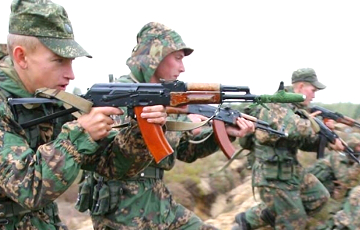
Belarus continues to check the system of tightening control over the state border and territorial defence.
“As part of the check of the system of tightening control over
the state border in the southern direction and territorial defence of
the Homel region, servicemen of the 38th guards separate mobile brigade
made a march accompanied by Mi-8 helicopters, passed to the control of
the command of the Mozyr border squad and began to implement joint tasks
on reinforcing the state border,” the press release says.
A
unit of the 103d separate mobile brigade of the special operations
forces of the Armed Forces marched to the area near the village of
Kastsiukouka in the Homel region. The servicemen practised repelling
attacks of the opposing force. Upon arriving at the destination, the
servicemen passed to the command of the border service, occupied the
position area and began to set up a camp.
The process of the
formation of the territorial defence headquarters and a separate
infantry squadron is continued in the Yelsk district of the Homel
region. “We completed the reception of reserve officers for the
formation of the territorial defence headquarters. It is planned to
acquaint them with their duties, give them weapons and ammunition form
the depot of the Armed Forces,” the Ministry of Defence adds. “The
deployment of the territorial troops is carried out to test the ability
of the Homel regional command to implement required tasks.”
What is the Eastern Partnership Summit
It is a big meeting of the leaders of the Eastern Partnership member
countries with high-rank European officials. The first such summit was
held on 7 May 2009 in Prague - it adopted a joint declaration on the EaP
program and formally approved it. It actually means that the Eastern
Partnership was launched in Prague. Then there were the summits in
Warsaw, Brussels and Vilnius. At the same time Belarus, unlike other
participants, has never been represented by the head of the country -
instead of Lukashenka the country was represented by the MFA head. What's going on there
All kinds of things do. For example, at the Brussels summit in 2012,
participants discussed Belarus. More precisely, they discussed the human
rights situation in our country. It was acknowledged that there is room
for improvement. At the last summit in Vilnius they were supposed to
sign the association agreement between the EU and Ukraine, Georgia and
Moldova. It did not really work well with Ukraine, as everyone knows,
that's why Maidan, Crimea, and the war in Donbass followed. What can happen at the summit in Riga
Basically, nothing serious can happen at the Summit. "There is not
much to be expected. Apart from, maybe, the signing of certain documents
on the visa regime facilitation. And it could happen some time after
the summit," warns political analyst Andrei Yahorau. Moreover, it is not
even about visa price reduction for Belarusians, but rather about the
streamliningn of procedures for diplomats and other VIPs. Thus, ordinary
citizens wll not notice anything except the catchy media headlines. Who will represent Belarus
Here is still a little mystery. The EaP Summit is the place for
geopolitical PR. Since the beginning of the spring, there have
circulated rumors on the sidelines of the Western Ministries about
Lukashenka getting an invitation. The rumor had it that the West could
even turn a blind eye to the fact that Lukashenka is stil on the EU
black list. The Belarusian Foreign Ministry has not disclosed the name
of its representative saying it is too early for that: "Currently, this
information
cannot be disclosed. The name of the Belarus representative at the Riga
summit will be made public as soon as there is a need for it."
The expert Yury Shautsou believes that the invitation and the visit
of Lukashenka to Riga could be another signal to the West - look, we are
in fact neutral and independent. However, Shautsou said that the
Eastern Partnership summit has not really taken serious decisions
before, so "there is little practical significance in the presidential
visit to Riga." Andrei Yahorau believes that the likelihood of this
visit equals zero: "Lukashenka is on the black list. To get him off it,
you need a solution of all the EU countries. This has not been the
case." Why the Eastern Partnership summits make Russia so angry?
the reason could be that Russia was not invited there, and the
participating countries like Georgia, Armenia, Azerbaijan, Moldova,
Ukraine, Belarus has long been perceived by the Kremlin as its sphere of
influence. In addition, one of the ideologists of the EaP was Polish
Foreign Minister Radoslaw Sikorski, and he is the sworn enemy of Kremlin
in the geopolitical field of Europe. In reality we see that the
Kremlin's fears are not entirely baseless - Moscow has lost Ukraine as
an ally if not for ever, then for a very long time.
The Belarusian dictator uses the same gangster tactic as
his Russian counterpart, but he applies it at home rather than using it
abroad.
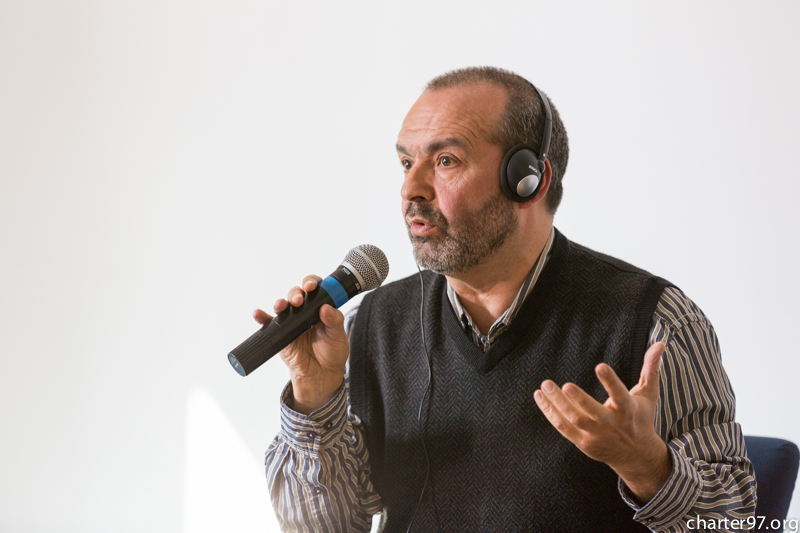
A meeting with prominent Russian journalist and writer Viktor Shenderovich
was held in Warsaw on May 18 as part of the presentation of his book
titled “Russia: How to Speak about It”. The event was organised by the
Polish Stefan Batory Foundation.
Ironical as usual, Viktor Shenderovich noted that “the smaller the room is, the higher the chances that you have a capacity audience”.
However, it is due to the talent of Viktor Shenderovich rather than the
size of the room that the conference hall of the Foundation was full.
The
writer answered many questions from the audience, consisting of
representatives of Polish, Belarusian and Ukrainian media and
organisations as well as people who like his books.
Journalists of charter97.org prepared a transcript of Viktor Shenderovich's answers. –
Russia look one-dimensional in the eyes of Europe. It is seized with
the “Crimea is ours” syndrome. This image is confirmed by opinion polls
conducted by Levada Centre that show Putin enjoys high support among the
Russians. Can this state be changed? Can the Russian opposition find an
approach to Russian citizens?
– As Professor Preobrazhensky said: “Do not read Soviet newspapers.” The key word here is “support”. Descartes
called on people to agree on the meaning of words. Europeans understand
the word “support” as a percentage of population that a politician can
rely on in the equal competitive struggle. This definition doesn't work
in authoritarian states. What support does the North Korean leader
have? If Levada Centre carried out an absolutely honest opinion poll in
Pyongyang, you would see that 99-100% of people support him. But ask
them if they want to wake up in South Korea, and you will get the same
result of 99-100%. Support in authoritarian states is the effect of a
pre-heated thermometer. It is the effect of fear and neurosis. If you
are asked “Do you support Komorowski, or do you want your legs to
be cut off?”, I assure you, you will say you support Komorowski. You
will get the same percentage to the question “Do you support Putin's
policy, or do you stand for the disintegration of Russia?” You cannot
use the word “rating” for authoritarian regimes. People are supposed to
receive information before the support is measured. People in democratic
countries receive information on equal conditions. The first step made
by authoritarian regimes is taking the media under control. Ceausescu had a 100% approval rating a week before he was shot. They all had 100% ratings, but then they were shot.
I
prefer to use my own sociology. A year ago, when Putin had his famous
84%, I organised a one-man picket with the poster reading “War in
Ukraine is disgrace and crime”. About 200 people passed by me. Six of
them said they didn't agree, 12 said they support me. From the rest, one
half passed by with no emotions, and the other half tried to hide their
eyes or demonstrated a neurotic reaction in other ways. Putin's
“sociology” define them as “supporters”. But the value of such support
is not high: it is the “support” through indifference and neurosis. We
need to distinguish the real support from the zone of fear, neurosis and
miserable being.
Today's situation looks dramatic even for Putin's closest cronies.
He cannot step down. He will go straight to The Hague once he quits. He
has nothing to lose. He knows it, and this knowledge in combination with
nuclear weapons is very dangerous. Many would like to jump off the
train that is going to derail. Many officials would like the first
decade of the “Putin epoch” to be returned. They would be able to rule
Russia like Uzbekistan and live the European lifestyle on what they
robbed. Unfortunately for them, the trap has shut,. They would like
Putin to disappear but the money they robbed to remain. Please don't
call it support. Otherwise we can speak about the “support” of Islam Karimov, Aliaksndr Lukashenka and Pol Pot.
This is the support from hostages. For those who know history, these
close to 100% ratings are a sign of the upcoming catastrophe.
How
to take Russia today? How to speak about Russia? Try not to mix up the
civilisation and the administration. The Russian civilisation is
unthinkable without Europe. Russia became great when it became a part of
Europe. In the 17th century, Russia was a territory outside the borders
of the evolution. Russia's famous 19th century is the result of
Russia's joining the European paradigm. It is important here not to
throw the baby out with the bathwater. Let's distinguish Putin's
terrible administration and the people of Russia, who are not the most
educated, from the civilisation that gave the world Tolstoy, Mendeleev, Chekhov and Tchaikovsky… –
Your thesis about “Putin's sociology”, “support out of fear”, a desire
of officials to jump off the train and crossing the point of no return
by the dictator resembles the situation in another country governed by
another man. I mean Belarus and Lukashenka.
– Technologies of the authoritarian power are quite simple and well known. Machiavelli
gave an exhaustive description of them. I am not sure if Lukashenka
read Machiavelli... I must admit that what Putin has done in the last
year plays into the hand of Lukashenka, because before that he was
considered to be the last dictator in Europe. It was his almost official
title. He cheered up after the events in Donbas. He is said to ask
recently, “Who is the last dictator? Am I the last?” If Lukashenka had
nuclear weapons, his name would be Putin and the world would take him
more seriously. Luckily, Lukashenka does not have nuclear weapons, so he
flies on his “golden helicopter” from Shklou to Brest, not doing much
harm to the planet. Belarus has the traditional dictatorship model.
Lukashenka is just lucky that Europe and world have bigger problems than
him.
– You mentioned the low quality of Putin's support and the
concept of hostages. Nevertheless, he enjoys support. Is there a chance
that civil society will appear in Russia and the facade won't just be
replaced “after Putin”?
– If I knew the answer, I would gamble
on stocks. Civil society cannot be exported from Mars. It is an
evolutionary process. As historian Natan Eidelman said, a period
of freedom in Russia lasts for 10-12 years, followed by decades of torn
nostrils and severe beating. After a period of degradation, when the
best was being destroyed, ahead of a new round of “freedoms”, we had
decent people – economists, philosophers, historians... Elites always
exist. The matter is whom people prefer to see in the elite – Professor
Preobrazhensky or Sharikov [characters of Bulgakov's novel Heart of a
Dog].
– Some EU politicians think there is a “thaw” now in Belarus.
Minsk is a mediator at the talks over Ukraine. Belarus is invited to the
Eastern Partnership summit in Riga…
– As for the so called
“Belarusian thaw”, I'd like to remind you an old Jewish joke: don't
confuse asthma and an orgasm. Aliaksandr Lukashenka continues to trade
and does it perfectly: he takes hostages – Andrei Sannikov and
others – and then releases them... This is the same gangster technology
that Putin uses, but Lukashenka applies it inside Belarus. Putin crossed
the border literally, while Lukashenka acts inside his country. This is
an old technology: North Korean leaders have been using it for 70
years, Cuba, Venezuela and other countries use it... Do not call it a
“thaw”. There were two thaws in Russian history: the first one when
emperor Nicholas I died, and the second one when Joseph Stalin died. Make your conclusions when the “Belarusian thaw” will begin.
Maira MoraChefen för EU:s representation i Belarus, Maira Mora, agerar i
strid med EU:s grundläggande värderingar och officiella politik. Därför
bör hon entledigas från sitt uppdrag. Det anser Östgruppen, som nu
uppmanar Sveriges regering att lyfta frågan internt inom EU.
– Istället för att tydligt ge uttryck för EU:s officiella linje till
stöd för demokrati och mänskliga rättigheter i Belarus har Maira Mora
vid upprepade tillfällen framträtt på ett sätt som snarare tjänar den
illegitima Lukasjenkaregimens intresse. Hon har därmed förbrukat sitt
förtroende som företrädare för EU, säger Östgruppens ordförande Martin
Uggla.
Maira Mora har flera gånger gjort den belarusiska demokratirörelsen
upprörd och besviken genom sina offentliga framträdanden. I höstas
medverkade hon till exempel i en pratshow i en statlig tv-kanal, och
uppmanade där alla belarusier att stötta president Lukasjenka. Den
aktuella pratshowen leds av Vadzim Hihin, som själv är föremål för
EU-sanktioner på grund av sin delaktighet i regimens
propagandaverksamhet.
Häromdagen deltog Mora på nytt i samma pratshow, och berömde där
Lukasjenka för dennes förmåga att ”umgås med folket”. Hon nämnde däremot
inte EU:s officiella krav på den belarusiska regimen att släppa alla
politiska fångar fria, trots att hon fick en uttrycklig fråga om vad som
i dagsläget hindrade en närmare relation mellan EU och Belarus. Samma
dag som pratshowen hölls stod landets mest kände politiske fånge – den
förre presidentkandidaten Mikola Statkevitj som suttit fängslad sedan
presidentvalet 2010 – inför rätta på nytt. I en domstolsförhandling som
människorättsförsvarare och EU-representanter nekades tillträde till
dömdes Statkevitj till en ytterligare skärpning av sitt fängelsestraff
på grund av påstådda brott mot fängelsets regelverk.
EU-delegationen i Minsk har under Maira Moras ledning fått ett allt
sämre rykte hos stora delar av den belarusiska demokratirörelsen. Många
upplever en tydlig ovilja från delegationens sida att engagera sig i
demokrati- och människorättsfrågor.
Östgruppen ser utvecklingen som bekymmersam och uppmanar Sveriges regering att lyfta problemet inom EU.
– Utrikesminister Margot Wallström har sagt att Sveriges och EU:s
Belaruspolitik tydligt ska ta ställning för demokrati och mänskliga
rättigheter. Den ambitionen måste också gälla EU:s representation på
plats i Belarus, och Sveriges regering bör göra vad den kan för att
åstadkomma detta, säger Martin Uggla. För mer information, kontakta:
Martin Uggla
ordförande, Östgruppen för demokrati och mänskliga rättigheter
070-941 17 02
A blogger called to the Minsk regional executive
committee to learn how he should register in accordance with
Lukashenka's order.
0
– Hello, this is the Minsk regional executive committee. –
Hello, my name is Yauhen Lipkovich. The president said in his address
yesterday that all Jews must be registered at Shapira's office. I am
calling you to learn how I can do it. – Could you hold on, please?
The call was put through.
– Hello.
–
Hello. I am Yauhen Lipkovich. The president said on television
yesterday that all Jews must be registered. I call you to learn how I
should do it.
– Many people call us every day.
– Do all of them want to be registered?
– Yes.
– Is the infrastructure ready?
– Do you want me to answer seriously or not?
– I want you to tell me the truth.
– Calm down, please.
– I am okay.
– Did you calm down?
– Yes.
– So, do you want me to answer seriously or not?
– Seriously, of course. The registration can be introduced retrospectively...
– Sorry?
– My wife is abroad. She says she won't return to the country. It's not funny.
– Eh... Hmm...
– What is your name? I didn't catch it.
– My name is Siarhei Paulavich.
– What is your job, Siarhei Paulavich?
– I work at the social and administrative department of the regional executive committee.
– What is your surname?
– I won't tell you my surname.
– Why?
– I don't want.
– But I'll ask in the office to whom they put me through.
He hang up. Yauhen Lipkovich
The dictator's remarks about Jews can violate criminal law.
Human rights defender Tatsiana Raviaka sent an electronic
appeal to the Prosecutor General's Office of Belarus, asking to assess
Lukashenka's order to “take all Jews under control”. “During his annual address to the nation and the parliament on April 29, Aliaksandr Lukashenka said to chairman of the Minsk city executive committee Siamion Shapira: 'I asked you a year ago to take all Jews in Belarus under control.' I
ask the Prosecutor General's Office to carry out a check and figure out
what control over this national group the head of state meant, in
connection with what circumstances and with what purpose,” the human rights defender quotes her appeal on Facebook.
Raviaka
also asked to assess Lukashenka's remark to find out if it violates
article 130 of the Criminal Code of Belarus “stirring up racial,
national or religious hatred”.
The human rights defender attached a video of Lukashenka's speech